

The heating cuts out on a cold London morning, and the boiler display shows a fault code you don’t recognise. You need heat and hot water, but you also want to know what’s safe to try and what a repair might involve. Clear advice on boiler repair London can help you handle the problem safely and understand what to do next.
A boiler fault doesn’t automatically mean you need a replacement. The right next step depends on the symptoms and what an engineer finds. If you suspect a gas leak, treat it as an emergency and follow official safety advice. Don’t open the boiler or attempt a repair yourself.
This guide explains what to check first, which signs need urgent action and how a Gas Safe registered engineer assesses a fault. You’ll also learn what information to have ready, how repair options are discussed and when replacement may be worth considering. The aim is to help you make an informed decision and know what to expect from a London heating engineer.
Key Takeaways
- Note unusual noises, leaks, repeated lockouts and loss of hot water to give the engineer a clear picture of the fault.
- A professional boiler repair London assessment can help identify the cause and explain your next steps in plain English.
- Repair or replacement depends on the boiler’s condition, fault history, parts availability and your heating needs, not age alone.
- Have your boiler details and any previous repair information ready, and clear safe access to the appliance and controls.
- Use a Gas Safe registered engineer for gas boiler repairs, and take urgent warning signs seriously.
London Boiler Repair: When Heating or Hot Water Fails
Losing heating or hot water can quickly disrupt daily life in a London home, especially when the fault appears without warning. A boiler may make banging or whistling noises, repeatedly lock out, leak water or stop providing hot water. These symptoms can have different causes, and a display code alone isn’t enough to diagnose the problem safely. For a simple overview of how boilers work, see Understanding Boiler Basics.
A loss of hot water can stem from the boiler, its controls or another part of the heating system. Note what has changed and check the thermostat settings if it’s safe to do so. Don’t remove the boiler casing, handle gas components or keep resetting an appliance that repeatedly shuts down. A reset may clear a symptom temporarily without fixing its cause.
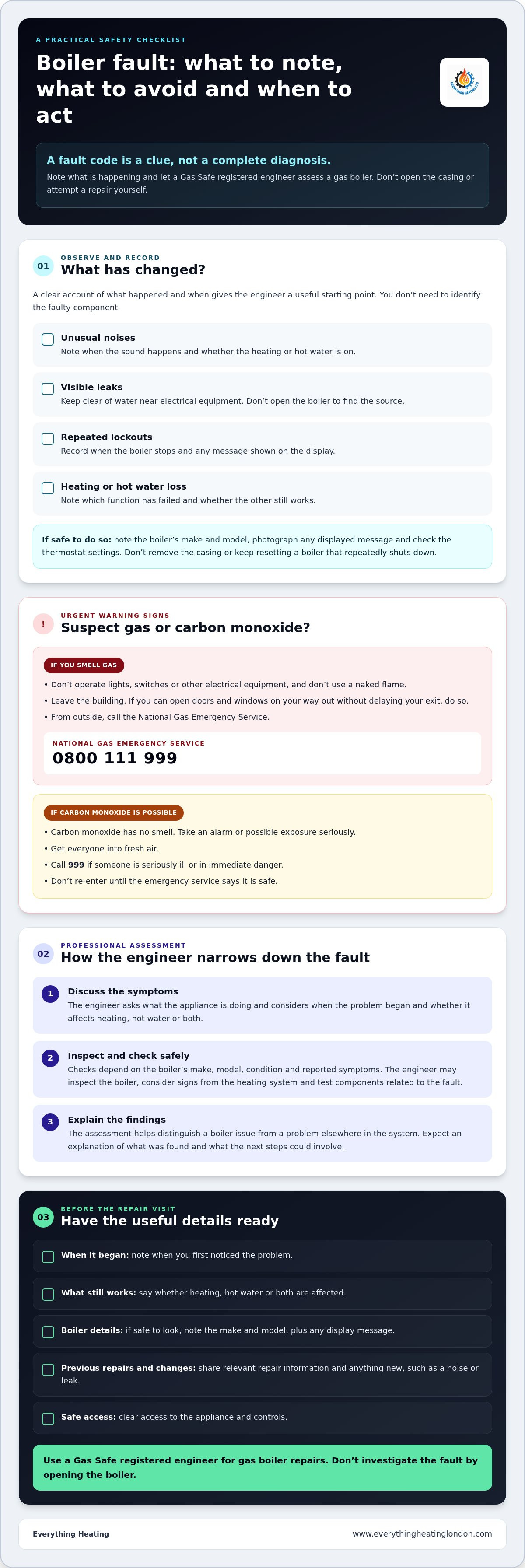
- Unusual noises: Note when the sound happens and whether the heating or hot water is on.
- Visible leaks: Keep clear of water near electrical equipment and don’t open the boiler to find the source.
- Repeated lockouts: Record when the boiler stops and any message shown on the display.
- No hot water or heating: Note which function has failed and whether the other still works.
Which boiler symptoms need prompt professional attention?
Arrange a professional assessment if the boiler keeps shutting down, you see a leak or notice an unusual smell around the appliance. Repeatedly resetting the boiler isn’t a safe substitute for finding the cause. Write down or photograph any displayed message, then leave the appliance alone until the fault can be assessed. Work on a gas boiler must be carried out by an engineer on the Gas Safe Register. A proper diagnosis can establish whether the issue is with the boiler or another part of the system.
If you suspect a gas leak or carbon monoxide, stop using the boiler, leave the property and seek emergency help; don’t wait for a routine repair visit.
What should you do if you suspect a gas or carbon monoxide problem?
If you smell gas, don’t operate lights, switches or other electrical equipment, and don’t use a naked flame. Leave the building. From outside, call the National Gas Emergency Service on 0800 111 999 and follow its instructions. If you can open doors and windows on your way out without delaying your exit, do so.
Carbon monoxide has no smell. Take an alarm or possible exposure seriously, particularly if anyone feels unwell. Get everyone into fresh air and call 999 if someone is seriously ill or in immediate danger. Don’t re-enter until the emergency service says it’s safe. Follow current advice from the Health and Safety Executive and emergency services; symptoms alone can’t confirm the cause. Once immediate danger has been addressed, a Gas Safe registered engineer can assess whether boiler repair London is the right next step.
How a London Boiler Repair Engineer Diagnoses the Fault
A reliable repair starts with identifying the cause, not guessing from a symptom or replacing a part because it seems likely. During a boiler repair London assessment, the engineer asks what the appliance is doing, checks it safely and explains what the findings mean. The checks depend on the boiler’s make, model and condition, as well as the symptoms you’ve reported.
What information helps identify a boiler fault?
Before the visit, note when the problem began and whether it affects the heating, hot water or both. If it’s safe to look, write down the boiler’s make and model and record any message on the display. Include changes you’ve noticed, such as a new noise or a visible leak. Don’t remove the casing or try to investigate the fault yourself.
These details give the engineer a useful starting point. A fault that appears only when you run hot water, for example, presents differently from a boiler that stops during both heating and hot-water demand. You don’t need to identify the faulty component. A clear account of what happened and when is more useful than a guess.
What happens during a professional boiler assessment?
The engineer will discuss the symptoms, inspect the boiler and consider relevant signs from the heating system. They may test components related to the reported fault. These checks help narrow down possible causes and distinguish a boiler issue from a problem elsewhere in the system. A Gas Safe registered engineer is required for work on a gas boiler; the HSE explains more about gas safety requirements.
A fault code is a clue, not a complete diagnosis. It may point towards an area to investigate, but it doesn’t always identify the failed part or explain why the fault occurred. The engineer considers the code alongside the symptoms, inspection and test results. Repeatedly searching for a code or resetting the boiler can’t replace a proper assessment.
After the checks, expect an explanation of what has been found and what the next steps could involve. If the engineer uses a technical term, ask what it means for your boiler and whether the fault can be repaired. A clear diagnosis should help you understand the reasoning behind the recommendation, rather than leave you with a list of unfamiliar component names.
Everything Heating Ltd provides boiler repairs in London, with professional fault assessment and a clear explanation of the options. Find out more about boiler repair from Everything Heating.
Boiler Repair or Replacement in London: How to Weigh Up the Options
Once the fault has been assessed, the next question is whether repairing the existing boiler remains practical. There isn’t one age threshold that decides this. A newer boiler can have a serious fault, while an older appliance may have a repairable problem. For boiler repair London, weigh the boiler’s condition, the fault and your household’s heating needs rather than relying on age alone.
When might repairing the existing boiler make sense?
Repair may be sensible when the assessment identifies a clear, isolated fault and the appliance is otherwise in reasonable condition. The engineer should consider whether similar problems have occurred before and whether the required parts are available. A history of reliable use is relevant, but it doesn’t guarantee that repair is the right choice. The condition of the wider heating system matters too.
When should replacement be discussed?
Replacement may be worth discussing if faults keep returning, the boiler has wider condition issues or the required repair isn’t practical. Your household’s needs also matter. Changes in how you use heating or hot water may affect which option suits you. A professional can explain the diagnosis and set out repair and replacement options so you can compare them before deciding.
To make the comparison clearer, consider:
- Condition: Is the problem limited to one fault, or are there signs of wider wear?
- Fault history: Has the same issue returned, or is this a new problem?
- Parts: Can the required parts be sourced, and does that make repair practical?
- Heating needs: Does the existing setup still suit your home and how you use it?
No single point settles the decision. An older boiler isn’t automatically beyond repair, and one repairable fault doesn’t prove that keeping the boiler is the right long-term choice. Ask the engineer to explain what was found, why an option is being recommended and what the next step involves. Proceed only when you understand the proposed work and its scope.
If repair is recommended, the estimate will depend on the fault and any parts required. If replacement is discussed, consider how a new boiler would fit your home and heating system, not just the appliance itself. The Energy Saving Trust offers impartial guidance on boiler efficiency and types, which can help you understand some of the choices. For readers considering a new system, this boiler installation guide for West London explains what to think about before moving from repair to installation.
Preparing for a Boiler Repair Visit in London
A little preparation can make a boiler repair London visit more straightforward. You don’t need to diagnose the fault or do any work yourself. A clear description of what’s happening, along with safe access to the appliance and controls, gives the engineer useful context before the assessment begins.
What details should you share when arranging a repair?
Describe what has stopped working and when you first noticed the problem. Say whether it affects the heating, hot water or both, and whether it happens every time or only occasionally. If it’s safe, note the boiler’s make and model and copy down any message on its display. Share relevant service or repair history if you have it.
Useful details to gather include:
- Boiler information: Make and model, if visible without removing a cover.
- Symptoms: What happens, when it happens and whether the issue is intermittent.
- Display message: A written note or photo, without trying to interpret or repeatedly reset it.
- Previous work: Any recent repair or service records that may help explain the history.
Describe what you observed rather than trying to name the cause. For example, explain that the boiler stops when you select heating, or that hot water cuts out after a short time. If the symptoms change before the visit, update your notes. Don’t repeatedly test the boiler to recreate a fault, and don’t touch components inside the casing.
How can you make access straightforward?
Before the visit, clear a safe route to the boiler and nearby controls, such as the thermostat or programmer. Don’t move, dismantle or disconnect equipment to make space. London homes vary, from flats with shared entrances to houses with restricted parking, so pass on practical details such as entry instructions, buzzer names and any parking arrangements that affect access.
Think through the route from the entrance to the appliance. If a concierge or building manager controls access, arrange the necessary instructions in advance. Move everyday items that block the approach, but leave the boiler and connected pipework untouched. If the appliance is in a cupboard, make sure its door can be opened safely. There’s no need to clear unrelated rooms or prepare tools.
Useful information and clear access help the engineer assess the fault. The repair and next steps will depend on what the assessment finds. Keep your notes handy and mention any change in symptoms when the engineer arrives.
When you’re ready to discuss a repair, arrange boiler repair with Everything Heating and share the details you’ve gathered.
Arrange Boiler Repair in London with Everything Heating
You’ve identified what the boiler is doing and considered what a professional assessment can tell you. The next step is to share the symptoms and arrange a repair assessment. Everything Heating Ltd provides boiler repair in London, focusing on identifying the fault and explaining the available next steps.
What to expect when arranging a repair with Everything Heating
When you get in touch, describe the boiler and the problem as clearly as you can. Share its make and model if you know them, what has stopped working, when the fault occurs and any message displayed. Mention relevant service or repair history too. You don’t need to identify the cause. Straightforward observations help the engineer understand the context.
The engineer will assess the reported issue and use the findings to explain the repair options and next steps. The right course depends on the fault and the boiler’s condition. If anything is unclear, ask for the diagnosis to be explained in plain English before deciding how to proceed. You should understand what has been found and what work is proposed.
Everything Heating Ltd is Gas Safe registered. Gas work must be handled by an appropriately registered engineer, so check the engineer’s Gas Safe ID card and registration details before work begins. This is a sensible step when arranging boiler repair London, and it helps you confirm that the engineer is qualified for the relevant gas work.
Where can you find related boiler guidance?
If you want to revisit what a repair visit involves, this London boiler repair guide covers the assessment process. If the findings lead you to consider replacing the appliance, the boiler installation guide for West London can help you explore that option. Repair and replacement are separate decisions; the assessment should explain which is being discussed and why.
There’s no need to prepare a technical explanation. Share what you’ve noticed, make the appliance safely accessible and let the engineer assess the fault. Clear information and a straightforward discussion can help you understand the options without guesswork.
Arrange a boiler repair assessment with Everything Heating and take the next step towards understanding your boiler fault.
Take the Next Step with Confidence
A boiler fault doesn’t have to leave you guessing about what comes next. Before arranging help, consider what you need from the conversation: a clear explanation of the fault, the proposed work and how it may affect your home’s heating. Ask for unfamiliar terms to be explained and take the time you need to understand the options before deciding.
For boiler repair London, Everything Heating Ltd provides repairs and is Gas Safe registered. A professional assessment gives you a practical basis for deciding what to do next, without assuming that every fault means you need a new boiler.
Share the symptoms you’ve noticed and arrange an assessment with a Gas Safe registered engineer. Arrange a boiler repair with Everything Heating and take the next step towards a clearer way forward.
Frequently Asked Questions
How much does boiler repair cost in London?
There isn’t one fixed price for boiler repair in London. The estimate depends on the fault, the work involved and any parts required. Before agreeing to a repair, ask what the estimate covers, including any diagnostic or call-out charge, labour and parts. Clarify whether further work would need your approval first. This helps you understand the proposed cost before deciding how to proceed.
Can I claim boiler repair on my home insurance?
Possibly, but it depends on your policy. Some home insurance policies exclude boiler breakdowns, while others may offer separate home emergency or boiler cover with limits, an excess or conditions about who carries out the work. Contact your insurer before authorising a repair if you intend to make a claim. Keep any claim reference and repair paperwork, and don’t assume the cost will be reimbursed.
Is boiler repair covered by a manufacturer warranty?
It may be, if the boiler is still within its warranty period and the fault meets the manufacturer’s terms. Cover can depend on registration, servicing records and exclusions in the warranty documents. Check your paperwork or contact the manufacturer before arranging repair, as using an unauthorised engineer could affect cover. Keep service records and previous repair invoices together in case they’re needed.
How long does a boiler repair usually take?
There’s no set duration for every repair. The time depends on what the assessment finds, the work needed and whether the required parts are available. A straightforward fault may be resolved during one visit, while a more involved issue could need further work or a return visit. Ask for an estimate of the work involved once the fault has been assessed, and allow access to the boiler and relevant controls.
Can a tenant arrange a boiler repair directly?
Tenants should usually report a boiler fault to their landlord or letting agent first, rather than authorising work or agreeing to pay for it themselves. The landlord or agent can arrange the repair and explain what to do under the tenancy agreement. Keep a record of when you reported the issue and any updates. If you suspect a gas leak or carbon monoxide, leave the property and contact emergency services.
What happens if a boiler cannot be repaired?
If an engineer finds that repair isn’t practical, they should explain why and discuss the next step with you. Depending on the boiler’s condition and your home’s heating needs, replacement may be considered. Ask why repair isn’t suitable and what a new installation would involve before making a decision. Don’t agree to replacement until you understand the findings and options.
Does an annual boiler service include repairs?
No, a service is routine maintenance and checks, not a promise to fix faults at no extra cost. If the engineer finds a problem during a service, they can explain what needs attention and discuss repair work separately. Ask which tasks are included in the service and whether any proposed repair requires separate approval. Keeping service records can also help you track maintenance and support warranty queries.


