

If you’re asking “power flush vs chemical flush which is better”, the answer depends on your heating system’s condition and the deposits affecting it. A more equipment-led clean isn’t automatically the right choice: the method should suit the circuit.
Cold patches on radiators, uneven heating or a system that takes a long time to warm up can be frustrating. These symptoms don’t automatically mean your system needs an intensive clean. Note what’s happening and which rooms are affected before deciding on a treatment.
This guide explains how chemical cleaning and power flushing differ, what each may help with, and how an engineer assesses which approach suits a system. You’ll also find practical steps to take before an assessment and what to expect from professional power flushing in London.
Key Takeaways
- The answer to “power flush vs chemical flush which is better” depends on the system’s condition and an engineer’s assessment.
- Both methods can use cleaning chemicals. The main difference is how the cleaning fluid is circulated and what equipment is used.
- Cold patches, slow warm-up or uneven heating are symptoms to report, not proof that a flush is needed.
- Check the basic heating controls and note which radiators are affected before arranging an assessment.
- Professional power flushing in London should begin with an assessment and end with checks suited to the system.
Power Flush vs Chemical Flush: What Is the Difference?
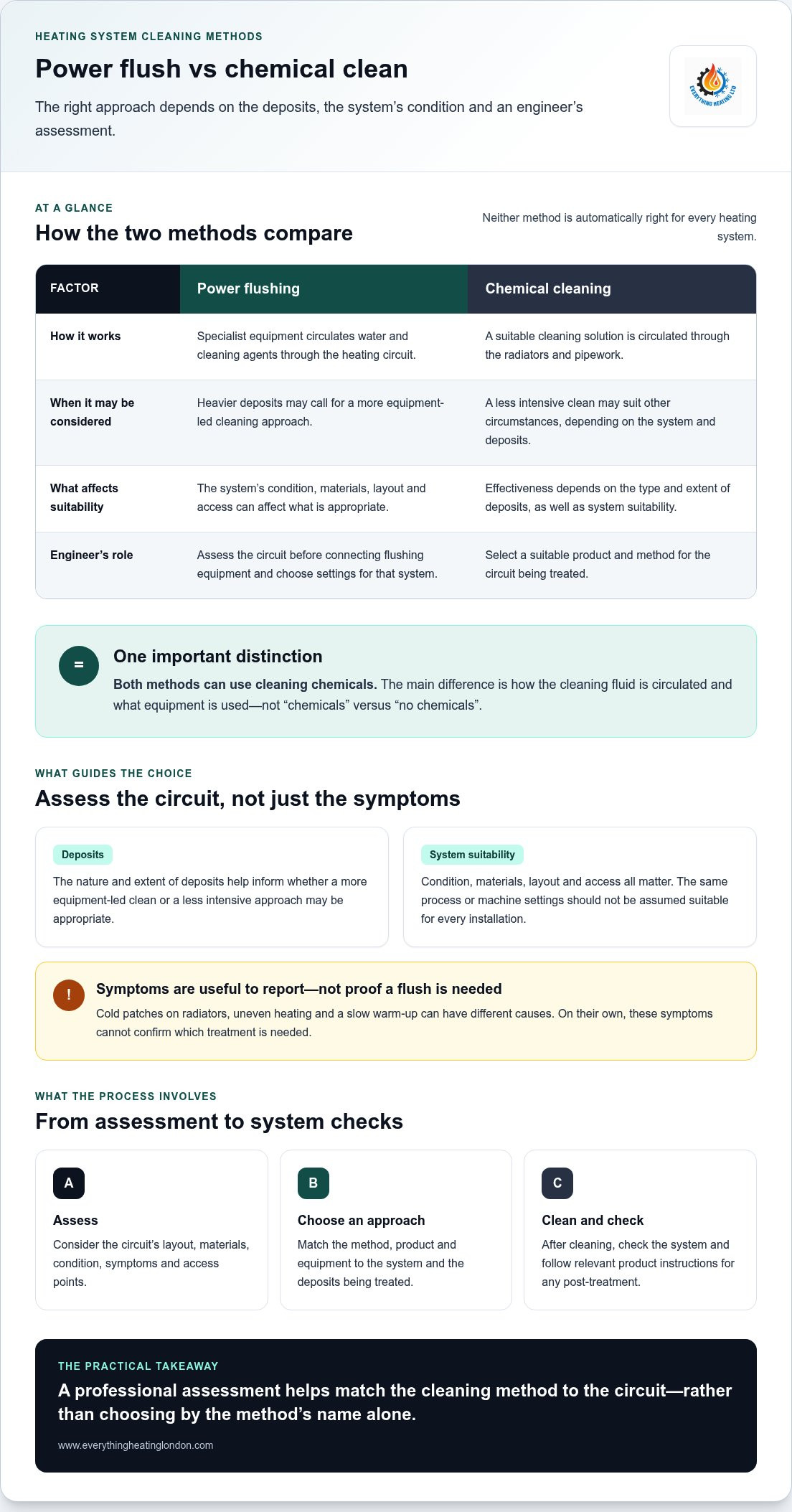
The right option depends on the heating system’s condition and an engineer’s assessment. A chemical flush circulates a suitable cleaning solution through the heating circuit. A power flush uses specialist equipment to circulate water and cleaning agents through it. Both approaches can use chemicals, so the difference isn’t simply “chemical” versus “no chemicals”. The main distinction is the circulation method and equipment.
A heating circuit connects the boiler, radiators and pipework that distribute warmth around your home. This is the basic arrangement of a central heating system. The layout and condition of these parts help an engineer decide how to clean the circuit appropriately.
What does a chemical flush involve?
A suitable cleaning solution is circulated through the radiators and pipework to help loosen and carry away deposits. The method and circulation time depend on the system’s layout and condition. Chemical cleaning doesn’t automatically mean every radiator must be removed. An engineer assesses the circuit and chooses a suitable approach.
What happens during a power flush?
For a power flush, an engineer connects specialist flushing equipment to the heating circuit. The equipment circulates water and cleaning agents through the system. The engineer may work through radiators individually and assess the water discharged during cleaning. This can show what is being flushed out, but it doesn’t by itself establish the cause of every heating problem.
The exact process varies with the system and equipment used. A power flush relies on specialist equipment, but it can still use cleaning agents. Chemical cleaning and power flushing can therefore overlap rather than being entirely separate treatments.
So, power flush vs chemical flush which is better? Neither method is automatically right for every home. The system’s condition, the nature of any deposits and the circuit’s suitability all matter. A professional assessment helps match the cleaning approach to the problem, rather than choosing based on the method’s name alone.
How the Two Heating-System Cleaning Methods Work
Both methods should start with an assessment of the heating circuit, rather than treating every home the same way. An engineer considers the system layout, materials, symptoms and access points before selecting an approach. A clean may involve circulating a cleaning solution, removing loosened debris, refilling the circuit as needed and checking the system afterwards.
A chemical clean circulates a suitable cleaning product through the heating circuit to help loosen deposits. A power flush uses specialist equipment to circulate water and cleaning agents through the circuit and remove loosened material. Neither description guarantees a particular result. The process and likely outcome depend on the system’s condition and suitability for treatment.
How a chemical cleaner is circulated
An engineer selects a cleaning product appropriate for the system and follows its instructions. The solution moves through the radiators and pipework to help loosen deposits it is designed to treat. This is different from simply adding a cleaner and assuming it will resolve the problem. System materials, layout and condition matter, so the circulation method and treatment time can vary.
How a power-flush machine cleans the circuit
For a power flush, specialist equipment is connected to the heating circuit and used to circulate water and cleaning agents. Where the system allows, the engineer may work through radiators individually. They can also assess the water discharged during the process and adjust the approach as needed.
There isn’t one pressure or equipment setting that suits every installation. Flow, pressure, machine settings and connection points should be selected for the particular circuit. System condition and access can affect what’s appropriate, so the same process shouldn’t be assumed suitable for every heating system.
After cleaning, the engineer checks the system and follows the relevant product instructions for any post-treatment. If an inhibitor is suitable, it should be used in line with its manufacturer’s guidance and the system requirements. This keeps treatment choices specific to the equipment and products involved, rather than relying on a one-size-fits-all routine.
Knowing what the process involves can help you understand the recommendation. If you’re in London and need professional power flushing, explore heating system services from Everything Heating Ltd.
Power Flush or Chemical Flush: Which Is Better for Your System?
The answer to “power flush vs chemical flush which is better” depends on the deposits present and whether the heating system is suitable for the method. A power flush may be considered when heavier deposits call for a more equipment-led clean. A less intensive chemical clean may suit other circumstances. Neither is right for every system, and symptoms alone can’t confirm which treatment is needed.
| Factor | Power flushing | Chemical cleaning |
|---|---|---|
| Process | Specialist equipment circulates water and cleaning agents through the circuit. | A suitable cleaning solution is circulated through the circuit. |
| Typical consideration | May be considered where heavier deposits call for a more thorough cleaning approach. | A less intensive approach may be considered when appropriate to the system and deposits. |
| System condition | Suitability depends on the system’s condition, materials and layout. | Effectiveness depends on the type and extent of deposits, as well as system suitability. |
| Assessment | An engineer should assess the circuit before using flushing equipment. | An engineer should select the product and method for the system being treated. |
When might power flushing be considered?
Persistent cold patches on radiators, slow warm-up or recurring circulation concerns can be clues that deposits may be affecting the system. They aren’t proof. Similar symptoms can have other causes, so an engineer considers your observations alongside the system’s age, condition and materials. Before using flushing equipment, they assess whether the circuit is suitable and choose an approach for that system.
When might chemical cleaning be considered?
A less intensive chemical clean may be considered after assessment if it appears appropriate for the circuit and the deposits involved. A cleaning product can only act on deposits it is designed to treat, so the type and extent of build-up matter. Chemical treatment isn’t a guaranteed fix for every blockage, circulation problem or boiler fault.
The system’s age is one part of the picture, not a decision on its own. Materials, overall condition and reported symptoms also help shape the recommendation. A careful assessment focuses on what the heating circuit needs, rather than assuming the most intensive method is always best.
How to Decide: Symptoms, System Condition, and Safety
Radiator symptoms can help an engineer understand what’s happening, but they can’t confirm that sludge is the cause. Before deciding between a power flush and chemical cleaning, make a few simple observations and arrange an assessment if problems persist.
- Note the symptoms. Record cold patches, uneven heating, repeated air or noisy pipework.
- Check basic controls. Make sure the heating is set to come on and the thermostat is calling for heat.
- Record what’s affected. Note which radiators and rooms are involved, and when the issue occurs.
- Arrange an assessment. Share your observations so an engineer can consider the system as a whole.
What radiator symptoms can tell you
A cold area on a radiator, especially near the top, can be associated with trapped air. Uneven warmth across different radiators may relate to balancing or circulation. Sludge can also affect how heat moves through a system, while a boiler fault may cause wider heating problems. These are possibilities, not remote diagnoses. Repeated air or noisy pipes are useful details to report, but don’t prove that a flush is needed. If you’re considering bleeding a radiator, follow a clear guide to bleeding radiators.
When a professional assessment matters
System age is only one factor. An engineer should also consider its condition, materials, signs of corrosion or leaks, and any previous maintenance before recommending treatment. This matters particularly if the system is old, leaking or appears vulnerable. Flushing equipment and cleaning products need to be suitable for the circuit; the same approach shouldn’t be assumed safe for every installation.
Everything Heating Ltd provides professional power flushing in London, with the process matched to the system’s condition. The company is Gas Safe registered. Gas Safe registration relates to gas work; it isn’t a guarantee of a particular flushing result. A professional assessment helps establish whether power flushing suits your system.
For a symptom-led assessment and professional power flushing in London, contact Everything Heating Ltd.
What to Expect from a Professional Power Flush in London
A professional power flush should begin with understanding the system, not connecting equipment straight away. The engineer discusses what you’ve noticed, reviews the heating circuit and considers whether power flushing is suitable. Preparation and the cleaning process depend on the property, the system’s condition and access to the circuit. There’s no fixed duration or guaranteed result for every home.
How an engineer matches the treatment to the system
The assessment can include the system layout, radiator condition and known maintenance history, alongside your symptoms. Details such as which radiators heat unevenly, whether the problem keeps returning, and whether the system has had previous work can help build a clearer picture.
Those findings guide the recommendation. Power flushing may be appropriate where the system and deposits call for it, while another suitable cleaning approach may make more sense in different circumstances. The decision should account for the condition and materials of the heating circuit, rather than assuming one method fits every property. If you’re still asking “power flush vs chemical flush which is better”, the answer comes from this assessment.
What happens during the process?
If power flushing is suitable, the engineer prepares the system and connects specialist equipment to circulate water and cleaning agents through the circuit. They may work through radiators where the system allows and monitor the water discharged as the process continues. Flow, equipment settings and access are selected for the installation. The engineer then refills and checks the system as appropriate, following the relevant product instructions.
After flushing: checks and ongoing care
Afterwards, the engineer checks the system’s operation. If inhibitor is appropriate, it should be used in line with the product instructions and relevant manufacturer guidance. Ongoing maintenance also depends on the system. If cold patches, noise or uneven heating return, report the symptoms rather than assuming another flush is needed. A recurring issue may need further investigation to identify its cause.
Everything Heating Ltd provides professional power flushing for customers in London. If an assessment points to this approach, arrange professional power flushing with a process chosen for your heating circuit.
Choose the Right Next Step for Your Heating System
So, power flush vs chemical flush which is better? It depends on the system’s condition, the deposits involved and whether the circuit is suitable for treatment. A power flush may be considered for heavier build-up, while a less intensive clean may suit other situations. Cold patches or slow heating are clues to investigate, not proof that a flush is needed.
Note which radiators are affected and when symptoms occur. A professional assessment can help distinguish possible debris from other causes and guide a suitable next step. The right approach should be based on your heating system, not a one-size-fits-all rule.
Everything Heating Ltd provides professional power flushing in London and is Gas Safe registered. To take the next step, arrange professional power flushing in London with Everything Heating Ltd.
Frequently Asked Questions
Is a power flush better than a chemical flush?
Neither method is automatically better for every heating system. The answer to “power flush vs chemical flush which is better” depends on the type and amount of deposits, the system’s condition and its suitability for treatment. A power flush may be considered for heavier debris, while a less intensive chemical clean may suit other circumstances. An engineer’s assessment helps identify an appropriate option instead of choosing by name alone.
What is the difference between a power flush and a chemical flush?
A chemical flush circulates a suitable cleaning solution through the heating circuit to help loosen deposits. A power flush uses specialist equipment to circulate water and cleaning agents through the circuit. Both methods can involve chemicals, so the distinction isn’t simply whether a product is used. The equipment, circulation method and system suitability help determine which approach may be appropriate for a particular heating system.
Can a chemical flush remove sludge from radiators?
A chemical cleaner may help loosen and remove deposits it is designed to treat, but its effectiveness depends on the type and extent of the build-up and the way it is used. It won’t necessarily clear every heavy deposit or blockage. An engineer can assess the heating circuit and select a suitable cleaning method. Persistent cold areas or poor circulation should be investigated rather than treated as proof that a chemical flush will solve the problem.
Can power flushing damage an old heating system?
It can be unsuitable for some vulnerable systems, so age and condition need to be assessed before flushing equipment is used. An engineer should consider signs of corrosion or leaks, system materials, layout and maintenance history, then select an appropriate process. Don’t assume an old system must be flushed or that it will inevitably be damaged. A professional assessment helps establish whether power flushing is suitable or another step is needed.
How do I know whether my heating system needs flushing?
Cold radiator patches, uneven heating, slow warm-up, repeated air or noisy pipework are useful symptoms to report, but none confirms that sludge is the cause. Trapped air, balancing problems or a boiler fault can create similar issues. Note which radiators and rooms are affected and when symptoms occur. A heating engineer can assess the system before recommending a flush. In London, Everything Heating Ltd provides professional power flushing.
How long does a power flush take?
A typical power flush takes around three to nine hours, although the time varies with the property and heating system. The number of radiators, circuit layout, access and system condition can all affect the work involved. An engineer can explain what the process is likely to involve after assessing the installation. Avoid relying on a fixed time estimate for every home, as each system may present different practical requirements.
Is a chemical flush enough for a central heating system?
It may be suitable in some circumstances, but it depends on the heating circuit and the deposits present. A chemical cleaner can help with deposits it is designed to treat, yet it may not resolve heavier build-up, a blockage or a fault elsewhere in the system. An engineer should assess the symptoms and system condition before recommending treatment. The least intensive suitable approach may be preferable, but it isn’t a universal rule.
Should I bleed radiators before arranging a power flush?
You can bleed a radiator if you know how to do so safely and it appears to contain trapped air, but bleeding isn’t a substitute for assessing persistent heating problems. Note whether air returns, which radiators are affected and whether other symptoms occur. Uneven warmth can have several causes, not just air or sludge. Share those details with the engineer so they can consider the system before recommending a power flush.


