

Heating accounts for about 53% of a typical UK household energy bill, yet much of that money is often wasted on trapped air rather than actual warmth. It is frustrating to hear strange gurgling noises whilst your London home stays chilly. You shouldn't have to deal with cold spots or rising costs when the solution is simple. Learning how to bleed radiators is the fastest way to fix these issues and restore comfort to your rooms.
We believe home maintenance should be transparent and stress-free. You deserve a warm house and the confidence to perform basic checks yourself. This guide shows you how to safely bleed your radiators to restore heat and keep your home cosy this winter. You don't need complex tools; a standard bleed key often costs less than a pound.
We will walk you through the process step-by-step. You will learn how to release trapped air and check your boiler pressure safely. We will also explain why bleeding is a vital first step, but why a professional power flush is often the best long-term solution for total system efficiency.
Key Takeaways
- Identify the main sign of trapped air: a radiator that feels stone cold at the top whilst remaining piping hot at the bottom.
- Master the simple process of how to bleed radiators to eliminate gurgling noises and improve your home's heating efficiency.
- Ensure your system stays functional by checking your boiler pressure gauge as soon as you have finished bleeding the air.
- Recognise when frequent air build-up or cold spots at the bottom mean you need a professional power flush rather than a DIY fix.
Recognising the Signs: Does Your Radiator Actually Need Bleeding?
Air is lighter than water. It's a simple fact of physics that dictates how your heating system behaves. When air enters your pipes, it naturally rises to the highest possible point. In most London homes, that point is the top of your radiators. This creates a stubborn pocket of gas that blocks hot water from circulating through the entire unit. Before you search for instructions on how to bleed radiators, you must confirm that air is the actual culprit.
You can usually identify a problem by checking for these specific signs:
- The top of the radiator is cold whilst the bottom is hot.
- The radiator makes gurgling, clicking, or banging sounds when the heating starts.
- Rooms take significantly longer to reach a comfortable temperature.
- Your boiler pressure has dropped or fluctuates unexpectedly.
These noises are essentially air bubbles moving through the pipes and getting stuck in the narrow channels of the radiator. Understanding what a bleed screw is helps you recognise that these small valves are your primary defence against these efficiency-killing air pockets. They are designed to let gas escape without allowing water to flood your floor.
Cold Spots vs. Cold Bottoms
Not all cold patches are created equal. If the top of your radiator is cold, bleeding the air will solve the problem. However, if you notice the bottom of the radiator is cold whilst the top is hot, you likely have a build-up of sludge or magnetite. This heavy, metallic debris settles at the base of the radiator and restricts water flow. Bleeding the air won't fix a cold bottom. In these cases, your system likely needs a professional power flush to clear the internal blockages and restore full heat.
The Impact on Your Heating Bills
With heating accounting for about 53% of the average UK energy bill, efficiency is paramount. When air is trapped, your boiler works significantly harder to reach the temperature set on your thermostat. It burns more gas to compensate for the radiators that aren't pulling their weight. Trapped air acts as an insulator, preventing hot water from filling the radiator. Learning how to bleed radiators can lead to immediate savings. By restoring the full thermal output of your system, you ensure every penny you spend on gas actually goes toward warming your home.
The Essential Kit: What You Need Before You Start
Preparation is the difference between a quick fix and a messy afternoon. Before you start learning how to bleed radiators, you must have the right tools within reach. The water inside your heating system is often black and oily due to internal corrosion; this liquid will ruin a light-coloured carpet in seconds if you aren't careful. Gathering your kit beforehand ensures you can act quickly once the valve is open.
You will need the following items:
- A Radiator Key: This is the standard tool for most UK central heating systems. A basic brass key can be purchased for as little as £0.99, though multi-functional keys are also available if you have older or unusual valves.
- A Flat-head Screwdriver: Many modern radiators have a slot in the bleed valve that accommodates a screwdriver, which is helpful if you've misplaced your key.
- An Old Towel and Absorbent Cloths: Lay the towel on the floor directly beneath the valve to protect your flooring. Use the cloths to wipe away any immediate drips from the radiator surface.
- A Small Container: A ramekin or a small plastic tub is perfect for catching the small amount of water that escapes once the air has been purged.
What if I Don’t Have a Key?
If you don't have a key, check the centre of the bleed valve. If there is a single horizontal slot, you can use a flat-head screwdriver. If the valve is square with no slot, you will need to buy a key from a local DIY shop or an online retailer. They are inexpensive and widely available. Avoid the temptation to use pliers or a wrench. These tools are too aggressive for the soft brass valves. They will round off the corners, making it impossible to grip the valve later. If your valves are already seized or damaged, it is often safer to book boiler repairs to have them replaced by an expert who can handle the job without causing a leak.
Safety Precautions: Cooling Down Your System
You must turn off your central heating before you begin. It's a vital safety step that many DIY guides overlook. When the heating is on, the water is under pressure and incredibly hot. Opening a valve whilst the system is active risks a face full of scalding steam or boiling water. Once you have switched the system off at the boiler or thermostat, wait for 30 to 60 minutes. This cooling period ensures the water is safe to handle. It also allows the air pockets to settle at the top of the radiator, which makes the task of how to bleed radiators much more effective. Patience here prevents injuries and ensures you get the air out on the first attempt.
Step-by-Step: How to Bleed Your Radiators Safely
Once your system has cooled down completely, you can begin the physical process. Cooling is essential because hot water under pressure is dangerous. Locate the bleed valve on your first radiator; it is a small metal plug usually found at the top corner of the unit. Position your towel and bowl directly underneath this valve. This prevents the dark, treated water from staining your floorboards or carpet.
Insert your radiator key or flat-head screwdriver into the centre of the valve. Hold your cloth around the key to catch any immediate spray. Turn the key slowly anti-clockwise. You don't need much force; a quarter or half turn is usually enough to open the seal. As you do this, you will hear a distinct hissing sound. This is the trapped air escaping. Keep the valve open until the hissing stops and a steady stream of water begins to trickle out. Close the valve immediately by turning it clockwise. Always close the valve firmly but without over-tightening, as you don't want to snap the internal pin.
Dealing with Different Valve Types
Most London homes feature standard square-peg valves that require a traditional brass key. However, if you have modern decorative radiators, the valve might be hidden behind a plastic cap or located at the back of the unit. Gently pop the cap off to access the screw. If the valve feels stuck or has been painted over, do not force it. Applying too much pressure can break the valve. Instead, try a small drop of penetrating oil or gently tap the valve with your key to break the paint seal. If it remains stubborn, it is a sign you need professional boiler repairs to avoid a snapped valve and a major leak.
Which Radiator Should You Bleed First?
The order in which you work matters for efficiency. Start with the radiator furthest away from your boiler. In a multi-storey house, you should always begin on the ground floor before moving upstairs. This logical progression follows the path of the water and ensures you push all the air out of the system systematically. By following this sequence, you ensure that knowing how to bleed radiators actually results in a fully restored heating system rather than just one warm room. Once you have finished the final radiator upstairs, you are ready to check your boiler pressure.
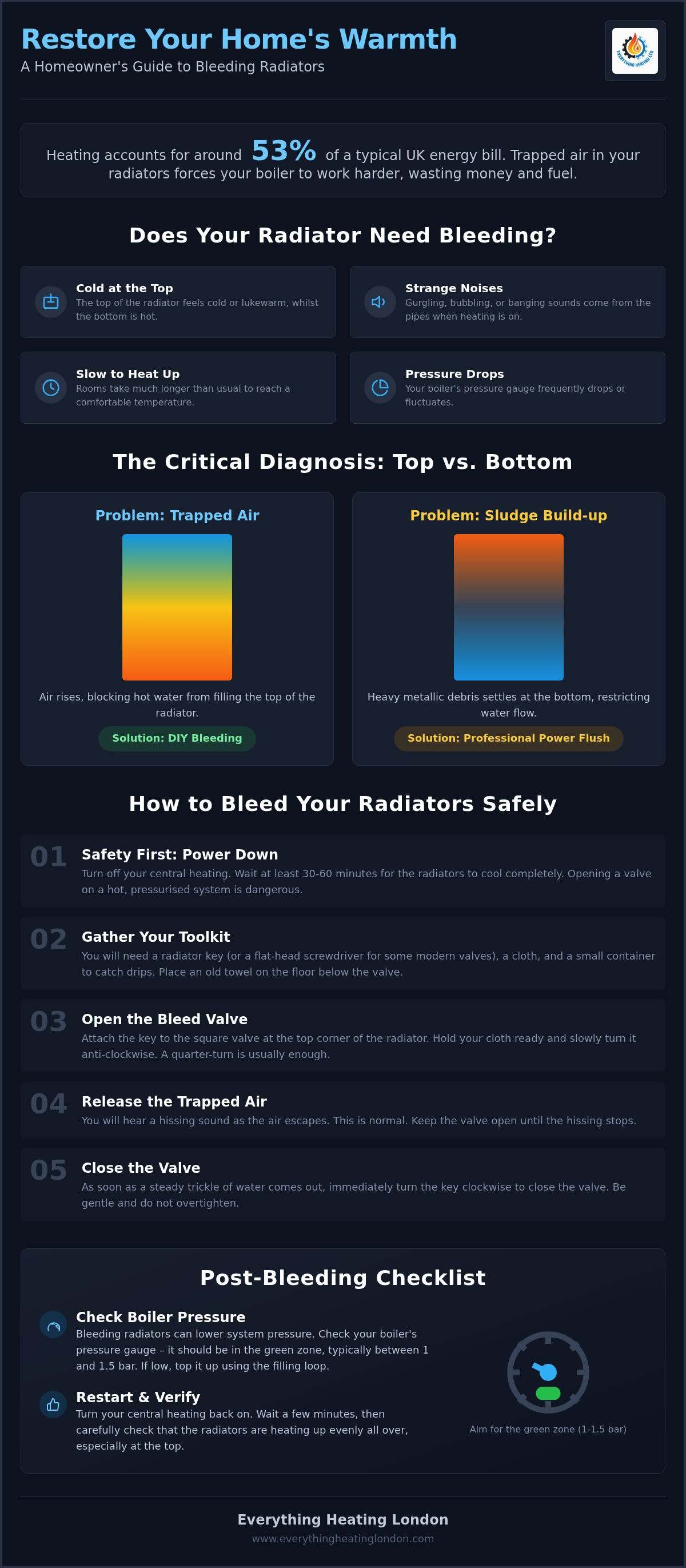
Post-Bleeding Checklist: Restoring Your System’s Balance
Many homeowners believe the job is finished once the water starts to trickle from the valve. It isn't. When you release air, you are also reducing the total volume of fluid inside your central heating pipes. This inevitably causes the system pressure to drop. If the pressure falls too low, your boiler will likely enter a lockout mode as a safety precaution. This means it won't fire up at all, leaving you with cold radiators despite your hard work.
Go to your boiler and find the pressure gauge on the front panel. It might be a traditional needle dial or a digital display. Look for the green zone. When the system is cold, the pressure should typically sit between 1.0 and 1.5 bar. If the needle has dropped into the red section below 1.0, you must manually top up the water levels to restore the balance.
How to Repressurise Your Boiler
To get your pressure back into the green zone, you need to use the filling loop. This is the flexible silver hose usually found directly underneath the boiler. It has two small valves, often with black plastic handles. Open both valves slowly and listen for the sound of rushing water. Watch the gauge carefully as the needle begins to rise. Once it reaches approximately 1.2 bar, close both valves firmly. Don't leave them open, as over-pressurising the system can cause the safety relief valve to leak. If you find this process confusing, it is best to consult a local heating engineer in London to guide you through it safely.
Checking for Leaks and Success
Turn your central heating back on and wait about 15 minutes for the water to circulate. Check every radiator you worked on to ensure they are heating up evenly. There should be no cold spots at the top. Use a dry tissue to wipe around the bleed valves you opened. They must be bone dry. Even a tiny, slow drip can lead to another pressure drop within a few days. If the gurgling noises persist or the radiators remain cold after you've mastered how to bleed radiators, it suggests a more deep-seated issue. Persistent air can indicate a small leak elsewhere or a failing pump. To prevent these minor issues from becoming expensive emergencies, consider booking professional boiler servicing to keep your London home efficient and warm all winter.
Beyond Bleeding: When Your Heating System Needs Expert Care
Bleeding your system is a brilliant first step, but it shouldn't be a weekly chore. If you find yourself constantly looking up how to bleed radiators because the same units keep filling with air, your system is likely drawing in gas through a small leak or a failing component. In a healthy, sealed system, air ingress should be rare. Ignoring frequent air build-up can lead to internal corrosion, eventually causing much larger problems for your boiler and pipework.
London's hard water presents its own set of challenges. High mineral content can accelerate the formation of internal debris, especially in older heating systems. Everything Heating Ltd specialises in diagnosing these complex, London-specific issues. We help you move past temporary fixes to ensure your home stays warm without you constantly reaching for the bleed key.
The Dangers of Radiator Sludge
If your radiators are hot at the top but stone cold at the bottom, air isn't the problem. This is a classic sign of radiator sludge. This thick, black mixture of iron oxide and rust settles at the base of the unit and acts as a physical barrier, preventing hot water from circulating. Whilst DIY chemical inhibitors can help prevent this, they often aren't enough to clear heavy blockages in older London properties. For a deep clean that restores your system to peak efficiency, you should consult our Power Flushing London guide.
Why Annual Servicing is Non-Negotiable
A well-maintained system is a safe system. For landlords, a Gas Safety Certificate (CP12) is a legal requirement, but for homeowners, an annual check is just as vital. It keeps your manufacturer's warranty valid and catches small faults before they turn into expensive boiler repairs in West London. Our Gas Safe registered engineers check your pump, expansion vessel, and heat exchanger to ensure everything is running perfectly.
Regular maintenance is the most effective way to prevent air build-up and sludge from forming in the first place. It gives you peace of mind that your heating will work when you need it most. Book your annual boiler service today to keep your system in top shape and your energy bills as low as possible.
Take Control of Your Home Comfort This Winter
Mastering how to bleed radiators is a vital skill for any London homeowner. It's the simplest way to remove cold spots, stop annoying gurgling noises, and ensure your heating system works as efficiently as possible. Remember to always check your boiler pressure once you've finished. If the needle stays in the green zone and your radiators are piping hot from top to bottom, you've successfully restored your system's balance.
However, if you're still dealing with cold bottoms or frequent air build-up, it's time to call in the experts. Minor issues can quickly escalate into expensive repairs if they are left unchecked. At Everything Heating Ltd, our Gas Safe registered engineers provide a no-nonsense, reliable service tailored specifically to London heating systems. We prioritse transparency and clarity, giving you peace of mind that your home is in safe hands.
Book a professional boiler service with Everything Heating Ltd today to keep your system running perfectly all year round. You've got the tools and the knowledge to keep your home cosy; we're here whenever you need that extra bit of expert support.
Frequently Asked Questions
Can I bleed a radiator whilst the heating is turned on?
No, you must never bleed a radiator whilst the heating is active. If the pump is running, it can actually draw more air into the system. More importantly, the water inside is piping hot and under high pressure. You risk being scalded by steam or boiling water. Always turn the system off and wait at least 30 to 60 minutes for the radiators to cool down completely before you begin.
What should I do if water doesn’t come out when I bleed the radiator?
If no air or water comes out, the bleed valve itself is likely blocked with paint or internal debris. You should also check your boiler pressure gauge. If the pressure is at zero, there isn't enough force to push the air out. Gently clear the valve hole with a pin. If it remains stubborn, don't force the key, as it may snap. You might need a professional to replace the valve.
Why does my radiator need bleeding every few weeks?
Frequent air build-up is usually a sign of a slow leak or internal corrosion. When water leaks out, air is drawn in to replace it. Alternatively, a chemical reaction between the water and the metal pipes can create hydrogen gas. If you are constantly searching for how to bleed radiators, your system likely needs a professional inspection to identify if a failing pump or a leak is the root cause.
How do I bleed a radiator if I have lost the key?
Check the centre of the valve for a horizontal slot. If it has one, you can use a standard flat-head screwdriver. If the valve is square and smooth, you will need to buy a replacement key from a DIY shop for about £1. Never use pliers to turn the valve. This will round off the soft brass corners, making it impossible for even a proper key to grip the valve in the future.
Will bleeding my radiators lower my boiler pressure?
Yes, bleeding your radiators will almost always cause the boiler pressure to drop. As you release air and small amounts of water, the total volume of liquid in the system decreases. Once you have finished the task, check your boiler's pressure gauge. It should be between 1.0 and 1.5 bar. If it's lower, use the filling loop to top up the system and restore the correct operating pressure.
What is the difference between bleeding and flushing a radiator?
Bleeding is a DIY task to remove trapped air that causes cold spots at the top. Flushing, or power flushing, is a professional service that removes heavy sludge and magnetite from the bottom of the system. If you know how to bleed radiators but the bottom remains cold, bleeding won't help. Flushing is required to clear these internal blockages and restore the full thermal efficiency of your central heating.
How often should I bleed my radiators in a hard water area like London?
You should check your radiators at least once a year, ideally at the start of autumn before the cold weather hits. In London, the hard water can contribute to faster internal scaling and corrosion if the system isn't properly treated with inhibitor. Whilst bleeding isn't affected by water hardness directly, an annual check ensures air isn't trapped and gives you a chance to spot early signs of sludge build-up before winter.
Can air in the radiators cause my boiler to make a whistling noise?
Yes, air pockets can lead to a noise known as kettling, which sounds like a whistling or banging kettle. Trapped air restricts the flow of water through the boiler's heat exchanger. This causes the water to overheat locally and turn into steam bubbles. Bleeding the air out often solves the problem. If the noise continues, it may indicate a limescale build-up, which is common in hard water areas like London.


