

Turning up your thermostat won't fix radiators that stay stone cold at the bottom. Across West London, mineral-heavy water and corrosive black sludge quietly choke central heating pipework, forcing boilers to work twice as hard for half the warmth. If you're dealing with noisy kettling or rooms that take hours to warm up, arranging an expert power flush Hounslow specialists carry out can restore your heating without the expense of an unnecessary boiler replacement.
Living with uneven heat is frustrating, and nobody wants rogue trades pushing quick drain-downs or risking leaks on delicate valves. You deserve clear, honest guidance about what your system actually needs. In this guide, you'll discover how professional power flushing removes stubborn sludge, protects your boiler heat exchanger, and restores rapid, balanced warmth across every floor. We'll also break down the critical symptoms to watch for, compare flushing against basic chemical dosing, and explain how British Standard BS 7593 compliance keeps your system safe and efficient.
Key Takeaways
- Learn how hard local water combines with black iron oxide sludge to restrict circulation and cause noisy boiler kettling.
- Understand why arranging a dedicated power flush Hounslow heating engineers carry out clears heavy debris far more effectively than standard chemical dosing.
- Discover the step-by-step flushing protocol, including high-flow reverse pumping and neodymium magnetic filtration, that cleans pipework without risking internal leaks.
- Find out how your property type, from 1930s suburban builds to Victorian conversions with microbore pipework, influences flushing pressure and equipment setup.
- See how full compliance with British Standard BS 7593 protects boiler warranties, restores rapid heat distribution, and improves fuel efficiency across your home.
Why Central Heating Systems in Hounslow Need Professional Power Flushing
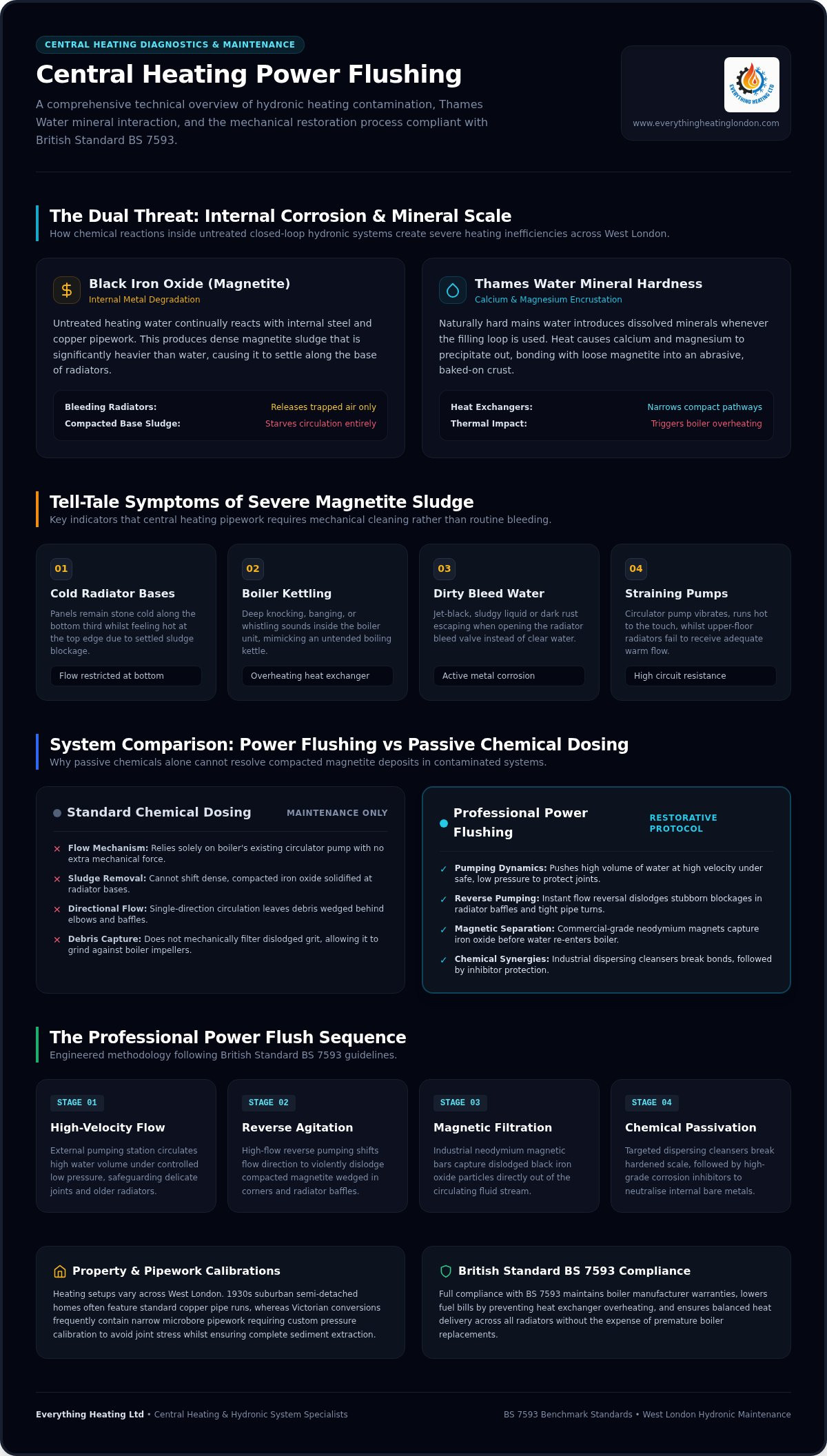
Central heating setups rely on smooth water circulation to push warmth from the boiler to every room. In closed-loop hydronic heating systems, untreated water reacts continually with internal steel and copper. This internal corrosion creates black iron oxide, commonly known as magnetite sludge. Because sludge is significantly heavier than water, it drops and settles directly along the base of your radiators, starving them of flow.
Bleeding your radiators only releases trapped air at the top. It does nothing to shift dense, compacted sludge sitting along the bottom panels. As these deposits solidify, the boiler faces massive internal resistance. It burns excess gas trying to reach the temperature set on the thermostat, driving up fuel bills while the rooms remain stubbornly chilly. Investing in a professional power flush Hounslow homeowners rely on breaks this cycle before major components suffer permanent damage.
Tell-Tale Symptoms of Magnetite Sludge in Your Radiators
Recognising system contamination early prevents costly mid-winter breakdowns. Common warning signs include:
- Cold radiator bases: Panels stay cool across the bottom third whilst feeling hot along the top edge.
- Boiler kettling: Deep knocking, banging, or whistling sounds inside the boiler unit, mimicking an untended boiling kettle.
- Dirty bleed water: Jet-black, sludgy liquid or dark rust escaping when you open the bleed valve instead of clear water.
- Straining circulator pumps: The pump runs constantly, vibrating hot to the touch while upper-floor radiators fail to warm up.
The Local Threat: Thames Water Limescale in West London Homes
Properties across Hounslow, Brentford, and Isleworth draw their water supply from Thames Water. This supply is naturally hard, carrying high levels of dissolved calcium and magnesium. Every time fresh water top-ups enter your system through the filling loop, heat triggers a chemical reaction. Minerals precipitate out of the water, crystallising into dense limescale.
Inside the pipework, this limescale combines with loose magnetite sludge to create an abrasive, baked-on crust. Modern condensing boilers feature narrow, highly compact heat exchanger pathways designed for peak fuel economy. When this mineral-sludge compound narrows those tight channels, water flow chokes. Heat cannot transfer smoothly into the system, forcing the heat exchanger to overheat rapidly. Booking an expert power flush Hounslow engineers conduct clears this stubborn encrustation, restoring proper flow and extending the lifespan of your boiler.
Evaluating Heating Cleans: Power Flushing vs Standard Chemical Dosing
Homeowners often wonder whether a bottle of off-the-shelf cleaning chemical poured into a header tank does the same job as mechanical machinery. The short answer is no. Passive chemical dosing relies solely on your boiler's internal circulator pump to move fluid around the circuit. While chemical dosing helps maintain clean systems, heavily sludged circuits require forced mechanical velocity to shift compacted magnetite. For an overview of investment considerations across the capital, read our guide on Power Flushing Cost London: 2026 Guide to Central Heating Efficiency.
High-Velocity Pumping Dynamics and Magnetic Separation
Professional flushing stations do not rely on excessive, damaging pressure. Instead, they push high volumes of water at high velocity under low pressure, protecting delicate joints and older radiators. Reversing the flow direction dislodges stubborn blockages wedged behind narrow pipe elbows and radiator baffles.
As dirty water rushes out of the central heating circuit, it passes directly across commercial-grade neodymium magnets. These high-strength magnetic bars capture loosened black iron oxide before the water can re-enter your boiler. This setup actively prevents circulating grit from grinding against delicate impellers or heat exchanger walls during the clean.
Specialist Chemical Formulations: Cleansers and Inhibitors
Mechanical flow works hand-in-hand with professional chemical treatments. Certified engineers use targeted compounds to restore internal water quality:
- Dispersing cleansers: Industrial-grade chemicals break the bond between hardened magnetite scale and internal metal surfaces.
- Neutralising flushes: Clean mains water flushes through until system pH tests completely neutral, ensuring no corrosive cleaning agents remain behind.
- Long-term inhibitors: A protective chemical barrier is introduced to coat bare internal steel and copper, preventing oxygen from triggering new rust.
Why a Basic Drain Down Never Solves Heavy Sludge Issues
Draining a heating system by gravity empties the dirty water, but dense sludge remains undisturbed at the bottom of the radiators. Refilling the circuit with untreated tap water introduces fresh oxygen, which immediately accelerates internal rusting. Industry bodies emphasise that maintaining system efficiency requires thorough water treatment rather than superficial drain-downs. If you simply have cool radiator tops caused by trapped air pockets, check our guide on how to bleed radiators instead.
Attempting a heavy mechanical clean without certified equipment risks rupturing worn seals or locking sludge directly into the boiler heat exchanger. Arranging an engineered power flush Hounslow heating specialists oversee ensures the entire circuit is safely purged, chemically balanced, and fully protected for winter.
The Professional Power Flush Process: What Happens on the Day
A proper heating cleanse is a structured engineering procedure, not a rushed splash-and-dash visit. Understanding what power flushing involves helps homeowners know exactly what to expect when an engineer arrives. A standard residential visit typically takes between five and eight hours, depending on system size, layout complexity, and contamination levels.
System Connection, Chemical Dosing, and Initial Heat Run
Your engineer begins by inspecting pipework integrity, radiator valves, and current pressure levels. Protective dust sheets keep floors safe before any hoses connect. The flushing station links directly across the central heating pump manifold or onto an easily accessible radiator tail.
Once connected, industrial cleaning chemicals enter the circuit. The engineer fires the boiler up to its standard operating temperature. Heat accelerates the chemical reactions, softening hardened scale and loosening baked-on deposits throughout the pipework.
Individual Circuit Cleansing and Mechanical Agitation
Thorough cleaning requires methodical radiator isolation. The engineer closes every radiator except one, directing the pump's entire flow velocity through a single circuit at a time.
- Targeted agitation: The engineer uses a specialised rubber mallet or gentle vibro-tool against the lower steel panels to dislodge dense, compacted sediment.
- Flow reversal: Flipping the flow direction violently disturbs settled silt sitting in narrow bottom corners and tight elbows.
- Magnetic capture: High-power neodymium filtration units continually pull freed magnetic debris out of circulation before it reaches other components.
This process repeats radiator by radiator across every floor until each panel shows uniform heat dissipation across its entire surface.
Fresh Water Dumping, Neutralisation, and Inhibitor Dosing
Once mechanical agitation breaks the sludge loose, contaminated water dumps directly into an external foul drain while fresh mains water enters simultaneously. Purging continues until every radiator flushes entirely clear.
The engineer then tests the system water using a calibrated total dissolved solids (TDS) meter. The reading must closely match your incoming cold mains water, confirming all chemical cleansers and suspended debris have left the system. Finally, high-grade chemical inhibitor is introduced to guard against future oxidation. If requested, an in-line magnetic filter is fitted onto the boiler return pipe to satisfy British Standard BS 7593 guidelines. Booking a comprehensive power flush Hounslow specialists conduct ensures your system leaves the visit fully balanced, clean, and functioning at peak thermal performance.
Assessing Hounslow Properties: Pipework, Boilers, and System Age
Every home has a unique plumbing history. Across the London Borough of Hounslow, heating systems span Victorian conversions with thick imperial pipework to newer builds fitted with modern barrier plastic. Because older systems handle hydrodynamic force differently, a skilled engineer always evaluates your property's pipe layout before turning on any equipment. Conducting this physical check ensures that carrying out a power flush Hounslow homes require restores efficiency safely without disturbing fragile joints.
Navigating 1930s Semi-Detached and Terraced Heating Layouts
Suburban housing stock across Osterley, Heston, and Isleworth predominantly features 1930s builds. Over several decades, many of these properties have had ground-floor rear extensions or conservatory heating loops added on. These extended branch runs often develop severe circulation issues because sludge collects naturally in the lowest, furthest legs of the system.
Corrosion can also leave original steel radiators thin beneath heavy paint. Experienced engineers inspect radiator seams, valve packings, and pipe elbows for weeping or severe pitting before introducing high-velocity flow. Taking this cautious approach prevents unexpected pinhole leaks and protects your living spaces.
Microbore Systems vs Standard 15mm and 22mm Copper Circuits
Pipe diameter dramatically changes how heating circuits perform. While standard modern installations run on 15mm and 22mm rigid copper, many late-20th-century estates rely on 8mm or 10mm flexible microbore copper:
- Narrow bore clogging: Compact 8mm lines restrict water volume quickly, meaning tiny amounts of magnetite sludge create full blockages.
- Calibrated pump velocity: Engineers reduce delivery pressure and extend chemical circulation times to clear narrow pathways safely without stressing joints.
- Plastic barrier pipework: Modern push-fit plastic runs require gentle handling to ensure internal O-rings remain completely watertight under reverse flow.
If an initial assessment reveals that internal parts like a diverter valve or secondary heat exchanger have already failed mechanically from severe debris, chemical cleansing alone cannot reverse the physical wear. In those cases, you may need targeted reliable boiler repair in West London before or alongside circuit cleansing.
For personalised advice tailored to your property's age and layout, speak with a local heating engineer Middlesex homeowners trust. When you are ready to book a thorough assessment, contact Everything Heating Ltd to arrange an engineered survey for your system.
Booking Your Power Flush in Hounslow with Everything Heating Ltd
Finding a dependable heating engineer shouldn't involve guesswork or aggressive sales tactics. At Everything Heating Ltd, we take a straight-talking, practical approach to domestic heating. If your system struggles with noisy pipework or stubborn cold spots, our engineers assess the core issue before recommending any work. Arranging an engineered power flush Hounslow residents can trust means restoring your home's comfort through methodical care, not temporary patches.
We pride ourselves on transparent communication from the moment you get in touch. You get clear technical guidance, honest advice, and work completed to the highest trade standards.
The Reassurance of Gas Safe Registered Local Heating Experts
Every heating circuit is different, and modern condensing boilers require careful handling. Our Gas Safe registered engineers bring extensive West London field experience to every appointment. We carry out cleans in strict compliance with British Standard BS 7593, protecting your boiler warranty and safeguarding sensitive internal components.
Crucially, we never push unnecessary services. If your system symptoms point towards an isolated mechanical fault rather than widespread sludge, we will tell you directly. Our diagnostic assessments focus purely on what your heating needs to run safely and efficiently.
Transparent Quotations and Straightforward Booking Steps
We believe pricing should be simple and predictable. When you request a quote for a power flush Hounslow service, we evaluate your system based on tangible factors: radiator count, boiler model, and pipework configuration. There are no hidden call-out charges or unexpected add-ons for essential chemical cleansers and inhibitors.
Arranging a visit with our team follows three straightforward steps:
- Share your system details: Tell us your property type, radiator count, and the specific heating issues you're experiencing across your home.
- Receive an honest appraisal: We outline the recommended work clearly, explaining whether full mechanical flushing or targeted maintenance is the right technical solution.
- Schedule your engineer visit: We book a dedicated date that fits your routine, providing prompt coverage across Hounslow Central, Hounslow West, Cranford, Isleworth, and Osterley.
Take control of your home heating this winter. Contact the team at Everything Heating Ltd to discuss your system and secure reliable, balanced warmth across every radiator.
Restore Dependable Warmth to Your Hounslow Home
Cold radiator panels, kettling boilers, and climbing gas bills don't have to define your winter. When mineral-dense Thames Water combines with internal rust, simple drain-downs won't fix the problem. Investing in an engineered power flush Hounslow homeowners rely on strips away compacted magnetite, protects delicate heat exchangers, and restores rapid, balanced heat across your entire circuit.
At Everything Heating Ltd, our Gas Safe registered heating specialists bring verified West London technical expertise directly to your doorstep. We work with strict compliance to British Standard BS 7593 water treatment regulations, combining commercial magnetic filtration with proven chemical inhibitors to protect your system long term. Best of all, we provide a transparent, straight-talking approach without high-pressure sales tactics or hidden extras. Ready to enjoy quiet pipework and even warmth in every room? Book your Hounslow heating assessment with Everything Heating Ltd today and get your heating running at its best.
Frequently Asked Questions
How much does a power flush cost in Hounslow for a typical home?
The total cost depends primarily on your property's size, the number of radiators, boiler type, and the severity of sludge build-up. A compact flat with five radiators requires significantly less time and chemical treatment than a large four-bedroom house with fifteen panels. Reputable engineers provide a tailored assessment based on your system's setup rather than one-size-fits-all figures, ensuring you only pay for the exact chemicals and time your system requires.
How do I know if my central heating system needs a power flush or a new boiler?
If your boiler fires reliably but radiators remain cold along the bottom, poor water circulation from sludge is usually the culprit. In contrast, recurring mechanical component failures, cracked heat exchangers, or boilers older than fifteen years often indicate replacement is more sensible. A Gas Safe registered engineer can test circulation and water quality first, saving you from replacing a sound boiler that simply needs an internal system clean.
Can a power flush cause leaks or damage older radiators in Hounslow properties?
A power flush operates at high flow rate rather than high pressure, which protects pipe joints from stress. However, if advanced corrosion has already created hidden pinholes under heavy rust deposits, removing that debris can occasionally reveal pre-existing damage. A qualified engineer always conducts a thorough pre-clean inspection of radiator valves and joints across your Hounslow home, advising you of any worn panels before starting work.
How long does a professional power flush take to complete from start to finish?
A standard domestic power flush typically takes between five and eight hours to complete properly. Rushing the process leads to poor results because each radiator must be isolated, mechanically agitated, and flushed until the discharge runs crystal clear. Larger properties with extensive branch circuits or heavy limescale encrustation may take a full working day to achieve complete system neutralisation and balanced chemical protection.
Will a power flush unblock microbore heating pipes common in West London homes?
Yes, provided the microbore pipework isn't completely seized solid. Narrow 8mm and 10mm copper runs require careful modulation. Engineers use tailored chemical mobilisers and reverse-flow pumping under controlled pressure to clear compact passages safely. When undertaking a power flush Hounslow technicians adjust their pump flow specifically for microbore installations, ensuring narrow pipe elbows clear without dislodging joints or creating excess resistance.
Is a power flush necessary before installing a new combi boiler?
Yes, thoroughly cleaning the circuit is essential. British Standard BS 7593 and major boiler manufacturers require a comprehensive clean before commissioning a new boiler on an existing system. If you leave old magnetite and limescale in your radiators, the debris circulates straight into your new appliance, potentially damaging the primary heat exchanger within weeks and invalidating your manufacturer warranty from day one.
How often should a central heating system undergo power flushing in hard water areas?
Most domestic systems benefit from a power clean every five to six years. However, in hard water regions like Hounslow, high mineral levels speed up limescale encrustation when top-up water enters the circuit. Maintaining protective chemical inhibitor levels and having a Gas Safe engineer test water quality during your annual boiler service helps prolong the intervals between major mechanical cleans.


