
A back boiler-to-combi conversion is a change to your home’s heating and hot-water system, not a like-for-like swap. If “replacing old back boiler with combi London” is on your search list, the key question is whether your home and household are suited to a combi. Existing pipework, available space, mains water supply and the fireplace or flue can all affect the work involved.
It’s sensible to get clear answers before committing. Decommissioning or removing the back boiler, fitting the new boiler and adapting the heating and hot-water system can affect the project’s scope and cause disruption. A combi isn’t right for every household, so start with an assessment of your property and how you use hot water.
This guide explains what affects combi suitability, what an installer may need to assess and what the conversion can involve. You’ll also find practical questions to ask about the fireplace, pipework, hot-water arrangements and the work included in a quote. Before choosing an installer in London, check their Gas Safe Register details and ask for a clear explanation of the proposed work.
Key Takeaways
- Check your household’s hot-water use and whether taps or showers often run at the same time before deciding if a combi may suit you.
- Ask an installer to assess your mains water flow and pressure, as these can affect how a combi performs in your home.
- When replacing old back boiler with combi London, compare written quotes by the work included, not just the boiler itself.
- Ask how access, pipe routes, flue position and any fireplace work could affect the conversion plan.
- Before agreeing the work, verify the engineer’s Gas Safe Register details and confirm they cover your postcode and the full scope you need.
Replacing an old back boiler with a combi in London means planning a conversion
A back boiler is fitted behind or within a fireplace and uses gas to heat your home and water. Many older systems store hot water in a separate cylinder, often in an airing cupboard. A combi works differently: it heats water on demand and doesn’t use a separate hot-water cylinder. The exact arrangement in your home depends on how the original system was installed. You can read more about how a back boiler works before discussing what may need to change.
A back-boiler-to-combi conversion replaces an existing heating and hot-water arrangement with a combi system, including any necessary changes to the boiler, controls and connected pipework. That doesn’t mean every property can accommodate a combi. The right recommendation depends on the building, existing system and how your household uses heating and hot water.
What changes when a back boiler is replaced with a combi?
The work may involve installing the new boiler in a different location, adapting pipework and changing controls. Depending on the agreed plan and site conditions, the old back boiler may need to be removed or safely disconnected. These details cannot be confirmed from a boiler description alone, so ask the installer to explain how they apply to your home.
There may also be fireplace, surround or chimney-related work to consider. The boiler’s position and flue route can affect what’s possible, while changes to the fireplace may need a separate assessment. Ask the installer to distinguish the heating work included in the proposal from tasks that may require another trade or further investigation.
Why a combi conversion is not always a like-for-like replacement
A straightforward boiler swap keeps the basic system arrangement. A conversion changes how hot water is provided. With a combi, water is heated on demand rather than stored in a cylinder, so household use and the home’s layout matter. The installer needs to consider pipe routes, a suitable boiler position and a workable flue route.
For example, a home with a cylinder and back boiler may need more than a new appliance to change to a combi. The installer should assess what can be reused, what needs altering and whether the proposed arrangement fits your household’s needs. If you’re considering replacing old back boiler with combi in London, arrange a site assessment and ask for a clear explanation of the proposed work before deciding.
Check whether a combi boiler suits your London home and household
A combi may suit you if you want water heated on demand and would like to remove a separate cylinder. Removing a cylinder may free cupboard space, but the layout and conversion work need to make sense for your home. The search phrase “replacing old back boiler with combi London” has no one-size-fits-all answer. Your household’s hot-water routines matter as much as the boiler’s position.
Use these points to prepare for an assessment, rather than trying to make the decision on your own:
| What to consider | What to discuss with the installer |
|---|---|
| Hot-water demand | How often does your household use hot water, and are there busy periods? |
| Simultaneous use | Do showers run whilst someone uses a kitchen tap or another bathroom? |
| Available space | Would removing a separate cylinder create useful space, and is there a suitable location for the combi? |
| Existing system layout | Where are the current boiler, cylinder and pipework, and what might need changing? |
Check water supply as well as household routines
A combi heats water as it passes through the boiler, so the mains water flow and pressure at your property need checking before an installer recommends one. Ask how these will be assessed. If your household regularly uses a shower and kitchen tap at the same time, describe that routine clearly. This gives the installer a more useful picture of your actual demand than the number of bedrooms alone.
Compare systems if demand is high
If several people often need hot water at once, ask the installer to explain whether a combi or another type of system better fits your household. Mains flow, property size and the design of the existing system need to be considered together. Don’t choose a boiler output based only on general advice. An assessment of your property is needed to confirm a suitable system and configuration.
A useful assessment connects your day-to-day needs with your home’s water supply and layout. The Chartered Institute of Plumbing and Heating Engineering provides a professional reference point for plumbing and heating. For advice specific to your London home, discuss your existing system and household requirements with a London boiler installation provider and ask what the assessment covers.
Compare the conversion scope, not just the combi boiler itself
Two quotes can specify the same new combi but include very different work. If you’re searching for “replacing old back boiler with combi London”, compare the written scope, not only the boiler or headline figure. The assessment should explain how the existing system will be adapted and identify any work that depends on what the installer finds at your property.
What should a back-boiler conversion assessment cover?
Ask the installer to inspect the existing boiler and system layout, trace the relevant pipework and assess the proposed combi location. The assessment should also consider the flue route, ventilation and access where relevant. Ask how the plan will deal with hot water, heating controls and existing radiators. These details help you understand whether the proposed work fits your home.
Access can affect how equipment and materials are moved through the property. Pipe routes, flue position and the condition of the fireplace or surround may also affect the scope. Make sure any fireplace-related work is clearly described, including whether it is part of the quote or needs separate assessment.
How to compare conversion quotes fairly
Read each quote alongside its assumptions. Check whether it covers the boiler work, system changes, controls and commissioning, as well as removal and disposal of old equipment. Ask whether making good disturbed areas is included and whether separate trades may be needed. If part of the job can’t be confirmed before work starts, ask how the installer will explain a change and seek your approval before proceeding.
Use this checklist when comparing London installer assessments:
- System and location: Has the installer inspected the existing boiler, pipework and proposed combi position?
- Flue and access: Are the proposed flue route, ventilation and access requirements explained?
- Heating and hot water: Does the scope say what will happen to the controls, radiators and hot-water arrangements?
- Old equipment and finishes: Are removal, disposal and making good included, excluded or subject to further checks?
- Unforeseen work: How will changes discovered during installation be explained, priced where applicable and agreed with you?
A clear scope shows what you’re agreeing to and where uncertainty remains. Before accepting the proposal, ask the installer to put inclusions, exclusions and any site-dependent work in writing.
Understand the back-boiler removal and combi installation stages
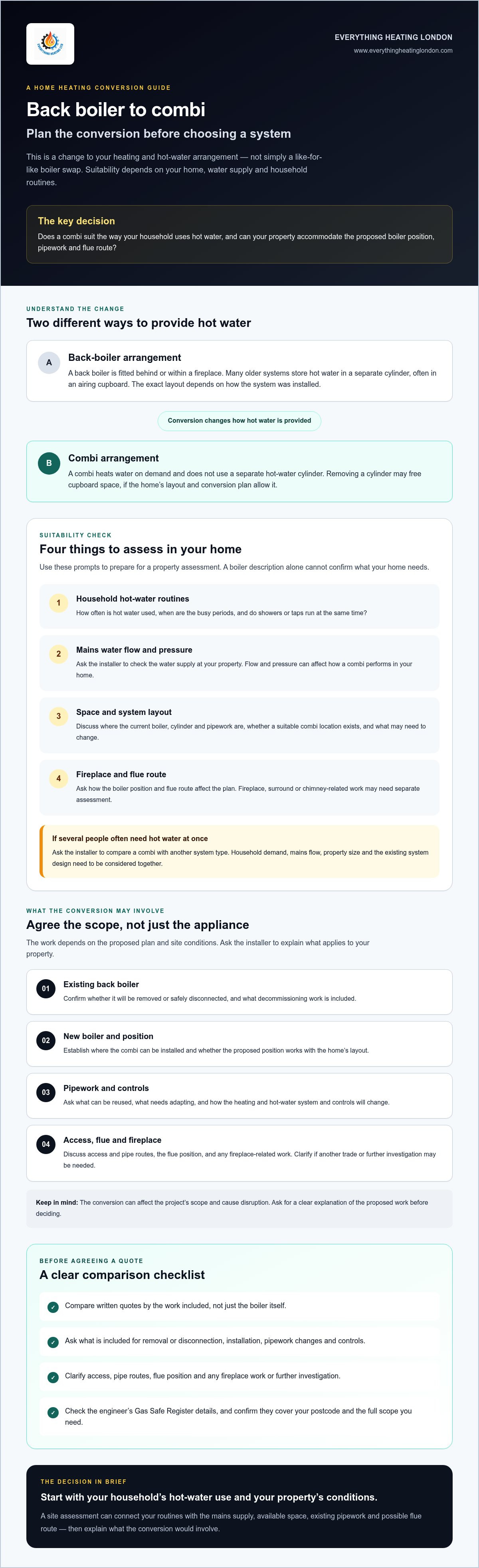
A back-boiler conversion usually follows a clear sequence, but the precise work depends on the survey and agreed scope. Before installation, the installer should confirm the proposed boiler position, how the existing heating system is arranged and what needs changing. Agree the plan before work starts, including who is responsible for any work outside the boiler installation.
From site survey to safe decommissioning
Ask how the old boiler and any affected components will be disconnected, removed or left safely isolated. Gas work must be carried out by an engineer who is Gas Safe registered for the relevant work category. Check the engineer’s details on the Gas Safe Register, and ask how decommissioning fits into the planned conversion.
Make practical arrangements in advance. Confirm when access is needed, which rooms or areas should be kept clear, and when you may be without heating or hot water. If the fireplace, surround or chimney needs repair or decorative making good, clarify whether that work is included or needs separate arrangements. Don’t assume the boiler installer will handle every part of the fireplace work.
Installation, checks and handover
Once the old equipment has been dealt with, the installer can fit and connect the combi and make the agreed changes to the heating system and controls. The engineer should then check the installation and commission the boiler. The exact checks and work completed depend on the system and the scope agreed for your home.
Before the installer leaves, ask for a clear handover. Make sure you understand how to use the boiler and controls, including how to adjust heating and hot-water settings. Ask what servicing arrangements are recommended and whether the boiler manufacturer has specific maintenance requirements. If anything differs from the agreed plan, ask for an explanation before additional work proceeds.
For a project such as replacing old back boiler with combi in London, preparation can make the installation easier to manage. Agree the expected work sequence with your installer and mention household routines or access needs that could affect the work. If you’re planning a conversion, discuss your back-boiler installation assessment and confirm which parts of the work the installer undertakes.
Choose a Gas Safe heating installer for your London conversion
A back-boiler conversion involves more than fitting a new appliance, so choose an installer who can explain the work clearly. Check the engineer’s details and relevant work category on the Gas Safe Register. Also confirm that the company covers your London postcode and undertakes the parts of the conversion you need, including back-boiler decommissioning. Don’t assume those tasks are included without checking.
Before agreeing to the work, ask for a written proposal that sets out what the installer will do, what’s excluded and what depends on the survey findings. If fireplace repairs or decorative finishing fall outside the scope, ask who will arrange them. This makes the division between heating work and any separate work at your property clearer.
Questions to ask a London boiler installer
Use the assessment to check that the recommendation reflects your home and household, not just the equipment being installed. Ask:
- What did the survey find about the existing system, pipework and proposed boiler location?
- Why does the recommended system suit our hot-water use and household routines?
- Which parts of the conversion will your company carry out, and which need separate arrangements?
- How will you explain the work programme, likely interruptions to heating or hot water, and what we should do to prepare?
- What will the handover cover, including use of the boiler and controls?
Clear answers matter. If something is uncertain, ask how the installer will discuss any change with you before proceeding. Comparing proposals this way helps you judge the work included, rather than relying on headline details alone.
Discuss your back-boiler conversion with Everything Heating Ltd
Everything Heating Ltd provides boiler installation and heating services in London. If you’re considering replacing old back boiler with combi London, describe your current system, property layout and hot-water requirements, then ask whether the company can assess the proposed conversion and confirm the work it undertakes. You can also read the West London boiler installation guide for related installation guidance.
You don’t need to decide on a combi before your property has been assessed. Discuss a boiler installation assessment as a first step, and make sure the proposed system and full scope are clear before proceeding.
Take the next step with a clear assessment
Replacing an old back boiler with a combi isn’t a like-for-like swap. Suitability depends on your household’s hot-water use, mains supply, system layout and the work needed around the boiler and fireplace. A site assessment can clarify which system may suit your home and what the conversion involves before you decide.
If you’re considering replacing old back boiler with combi London, compare written proposals and check the engineer’s Gas Safe Register details and relevant work category. Everything Heating Ltd provides boiler installation in London and is described as Gas Safe registered. Confirm current registration, ask whether the company undertakes the full conversion work, and check that your postcode is covered.
Arrange a London boiler installation assessment to discuss your existing back boiler and household requirements. Get clear answers about suitability, scope and next steps before deciding how to proceed.
Frequently Asked Questions
Can I replace an old back boiler with a combi boiler?
Yes, a back boiler can sometimes be replaced with a combi, but a site assessment must confirm whether it suits your home. The conversion may involve more than changing the appliance, including alterations to pipework, controls or the boiler’s position. In London, ask an installer to inspect your existing system and explain the proposed work in writing before you decide.
What happens to the fireplace when a back boiler is removed?
The fireplace may need changes, depending on how the back boiler is installed and what you want the finished area to look like. Removing equipment can affect the fireplace, surround or chimney area. Ask the installer what the conversion scope includes and whether repairs or decorative making good need separate arrangements. Don’t assume fireplace work is covered by a boiler installation quote.
Is a combi boiler suitable for every home with a back boiler?
No. Suitability depends on your property, mains water flow and pressure, existing pipework, available boiler location and household hot-water use. For example, tell the installer whether showers and kitchen taps are often used at the same time. The installer should consider these factors during a site assessment and explain if another system may be more appropriate. Don’t choose a combi based on general advice alone.
How long does it take to replace a back boiler with a combi?
The time needed varies with the property and the work identified during the survey. Access, pipe routes, the new boiler position and any fireplace-related work can all affect the programme. Ask the installer for an expected schedule after they’ve assessed your home, and clarify when heating or hot water may be interrupted. Agree access and household preparations before work begins.
Do I need a Gas Safe registered engineer to replace a back boiler?
Yes. In the UK, gas work on appliances must be carried out by a Gas Safe registered engineer with the relevant work category. Before agreeing to an installation, check the engineer’s details and qualifications on the Gas Safe Register. This is important for a back-boiler conversion, which may include disconnecting old gas equipment as well as installing a new boiler.
Will replacing a back boiler with a combi remove my hot-water cylinder?
A combi heats water on demand and doesn’t use a separate hot-water cylinder, so a conversion may allow an existing cylinder to be removed. Whether it will be removed as part of your project depends on the system layout and agreed work. Ask the installer to state in writing whether cylinder removal and disposal are included, and whether the freed space can be left ready for another use.
What should a quote for a back-boiler-to-combi conversion include?
A clear written quote should describe the boiler installation and any planned changes to the system, pipework and controls. Check whether it includes safe decommissioning, removal and disposal of old equipment, commissioning and handover. It should also identify exclusions, such as fireplace repairs or decorative making good, and explain how unexpected work will be discussed and approved before it proceeds.
How do I find a back-boiler replacement installer in London?
Look for a London installer who can assess your home, explain the proposed system and provide a clear written scope. Verify the engineer’s Gas Safe Register details and relevant work category, confirm that your postcode is covered, and ask whether the company undertakes the full conversion. Everything Heating Ltd provides boiler installation in London. Confirm its current registration and the conversion work it can carry out before proceeding.


