

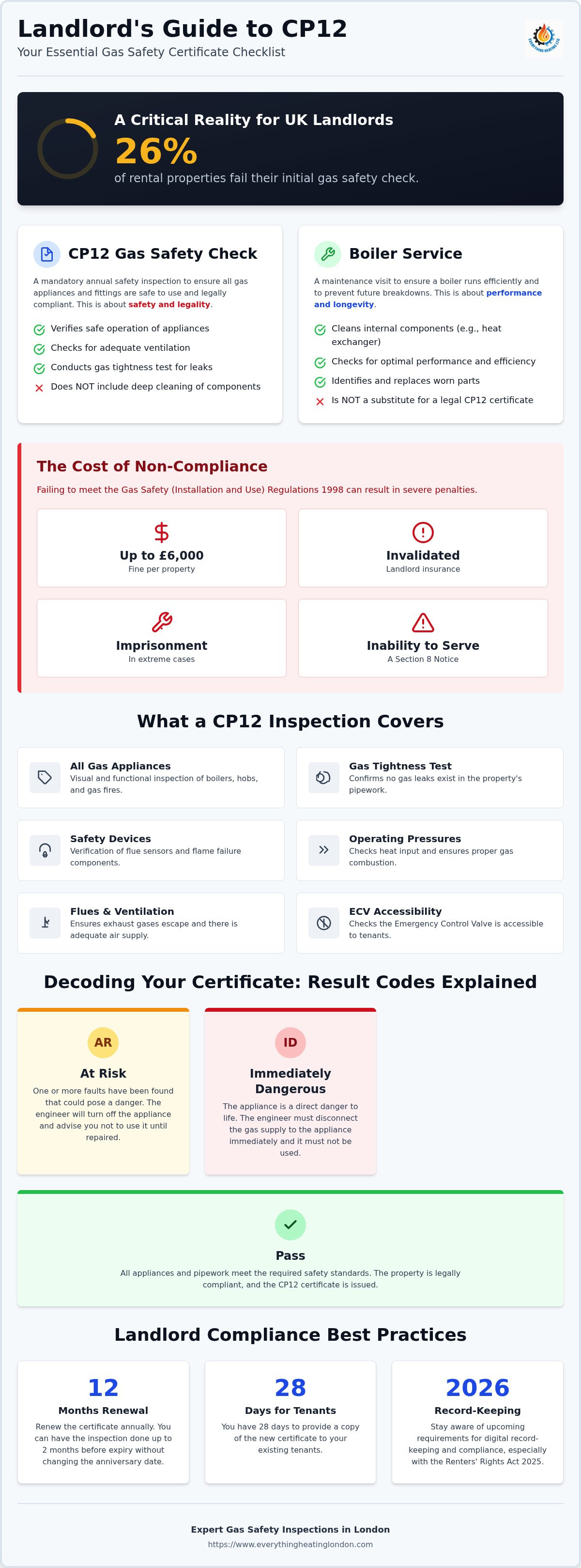
Did you know that 26% of rental properties in the UK fail their initial gas safety check? It's a sobering thought for any London landlord. When you're trying to understand a CP12 inspection what it covers, the fear of failing and facing expensive repairs is a constant worry. We know many landlords also feel confused about the difference between a standard boiler service and a legal gas safety check. This uncertainty often leads to unnecessary anxiety over council fines and legal compliance.
We believe in straight-talking advice that makes your life easier. In this guide, you will discover exactly what happens during the visit so you can ensure your property is fully compliant for 2026. We promise to walk you through the entire process, from checking gas appliances to testing ventilation. You will also get a clear understanding of the difference between AR and ID warning codes. By the end of this article, you'll have the peace of mind that comes with knowing your property is safe and your paperwork is in order. It's time to take the guesswork out of gas safety.
Key Takeaways
- Understand exactly what a CP12 inspection covers, including visual checks on all gas appliances and a full tightness test of your property's pipework.
- Stay legally compliant with the Gas Safety (Installation and Use) Regulations 1998 to avoid fines of up to £6,000 and potential imprisonment.
- Decode the technical jargon of your certificate by learning the difference between "At Risk" (AR) and "Immediately Dangerous" (ID) warning codes.
- Discover the 2026 requirements for record-keeping and how to manage the 28-day window for providing certificates to your tenants.
- Ensure your London rental property is safe for your tenants while protecting your insurance and maintaining your right to serve a Section 8 notice.
What is a CP12 Inspection and Why is it Mandatory?
If you're a landlord, the term CP12 is likely already on your radar. Officially known as the Landlord's gas safety certificate, this document is a legal requirement for any rental property with gas appliances. The name stems from 'CORGI Proforma 12', though CORGI was replaced by the Gas Safe Register years ago. Under the Gas Safety (Installation and Use) Regulations 1998, you're legally responsible for the safety of your tenants. This means ensuring all gas fittings and flues are maintained in a safe condition. Only a Gas Safe registered engineer can carry out this work. It isn't just a box-ticking exercise; it's a vital safety audit that protects lives.
The Legal Obligations for London Landlords
London councils are tightening their grip on compliance. With the introduction of the Renters' Rights Act 2025, having an up-to-date record is more critical than ever. You must renew the certificate every 12 months. However, you can arrange the inspection up to two months before the current one expires without losing your original anniversary date. This 'staying valid' window helps you stay organised and avoid last-minute panics. Don't ignore it. Failing to provide a valid record can lead to fines of up to £6,000 per property. In extreme cases, it can lead to imprisonment or the invalidation of your landlord insurance. It also prevents you from serving a Section 8 notice if you ever need to regain possession of your property.
CP12 vs. Boiler Servicing: Clearing the Confusion
Many landlords ask about a CP12 inspection what it covers compared to a standard boiler service. They aren't the same thing. A boiler service is about maintenance; it focuses on cleaning components and ensuring the unit runs efficiently. A CP12 is a safety check. It verifies that the appliance is safe to operate, the ventilation is adequate, and there are no gas leaks. Whilst a service keeps the boiler healthy, the CP12 keeps the property legal.
We often recommend combining these visits. It's more efficient than booking two separate appointments. During a combined visit, our engineers look at the safety aspects required by law and the performance details that prevent future breakdowns. A standard CP12 inspection what it covers might skip the deep cleaning of a heat exchanger that a service includes, so doing both ensures total peace of mind for you and your tenants.
The 11-Point Checklist: What the CP12 Inspection Covers
To understand a CP12 inspection what it covers, you need to look at the systematic audit of every gas appliance and the entire supply system. It isn't just a cursory glance at the boiler. Our engineers perform a full visual and functional inspection of boilers, hobs, and gas fires to ensure they operate as the manufacturer intended. We check for stable flames and ensure there is no soot build-up on the burners. We also conduct a gas tightness test at the meter. This is non-negotiable. It confirms there are no leaks within the property's pipework, protecting your building and your tenants from potential fire hazards.
A thorough CP12 inspection what it covers also ensures that every safety device is functioning correctly. We verify the operating pressures and heat input for each appliance. If these are off, the appliance might be burning too much gas or failing to combust properly. Safety devices like flue sensors and flame failure components are designed to shut the system down if something goes wrong. Ensuring they work is a key part of your legal duties for gas safety as a London property owner.
Flues, Chimneys, and Ventilation
A safe appliance is useless if the exhaust gases can't escape. We check the integrity of the flue throughout its entire length. In many London flats, flues run through ceiling voids. If your property was built or renovated after 2000, you likely need inspection hatches. Without these, an engineer cannot confirm the flue is safe, which could lead to an 'At Risk' result. We also ensure there is an adequate air supply. Proper ventilation is essential for complete combustion and preventing the build-up of deadly carbon monoxide.
The Gas Meter and Pipework Audit
The inspection extends to the source. We audit the gas meter for damage or signs of tampering. It's also vital to check that all pipework is correctly supported and sized for the appliances it serves. We look for the Emergency Control Valve (ECV) to ensure it's easily accessible. If there's a leak, your tenants need to be able to turn off the gas supply instantly. If you're unsure if your property meets these standards, you can book a professional assessment with our team to stay ahead of any issues.
Understanding the Results: Pass, AR, and ID Codes
Your certificate isn't just a pass or fail document. It's a detailed safety report that uses specific industry codes to highlight the condition of your gas system. When you look at a CP12 inspection what it covers, you'll see a list of appliances and their safety status. A "Pass" means everything is safe and meets the required standards. However, if an engineer finds a fault, they'll use a warning code to explain the severity of the issue. Understanding these codes is a core part of your Landlord gas safety responsibilities.
The "At Risk" (AR) code is used when a fault is present that could become a danger. It isn't an immediate threat, but it needs attention. We usually recommend repairs within a specific timeframe to prevent the situation from worsening. On the other hand, "Immediately Dangerous" (ID) is the most serious result. This means the appliance is a direct threat to life, often due to a gas leak or carbon monoxide risk. In these cases, the engineer is legally required to disconnect the appliance for safety. You might also see "Not to Current Standards" (NCS). This means the installation was safe when it was fitted but doesn't meet modern building regulations. It doesn't mean you've failed, but it's a helpful heads-up for future upgrades.
What Happens if Your Property Fails?
If an appliance is labelled AR or ID, our engineer has a duty of care to make the property safe immediately. This often involves capping off the gas supply to the specific appliance. It's a stressful moment, but it's essential for your tenants' safety. As a landlord, you're responsible for arranging the remedial works. Once the repairs are complete, the system must be re-tested to ensure it's safe. We always suggest being transparent with your tenants. Explain that the disconnection is a safety measure, not a punishment, and give them a clear timeline for the fix.
Common Reasons for CP12 Failure in London
London properties present unique challenges. In Victorian conversions, we often find poorly ventilated appliances tucked into small kitchens. Without enough fresh air, these appliances can't burn gas safely. Another frequent issue is outdated pipework. Over decades, small joints can weaken, leading to tiny leaks that fail the gas tightness test. In modern apartment blocks, missing flue inspection hatches remain a top reason for failure. Even if the boiler is brand new, a CP12 inspection what it covers must include a full flue check. If we can't see the flue, we can't pass it.
Landlord Best Practices: Managing Your Gas Safety Records
Managing your paperwork is just as vital as the physical check itself. Once the engineer finishes, you have a strict 28-day window to provide a copy of the CP12 to your existing tenants. If you're starting a new tenancy, the law is even stricter. You must hand over a valid certificate before the tenants move in. This ensures they're aware of the safety status of the property from day one. Failing to do this isn't just poor practice; it can invalidate your ability to serve certain legal notices later on.
The law requires you to keep a record of every gas safety check for at least two years. We recommend keeping them for the duration of your ownership. It builds a clear safety history for the property. A proactive approach to a CP12 inspection what it covers includes a solid filing system. Don't wait for the full 12 months to pass before booking your next visit. We suggest a "10-month" rule. By booking two months early, you maintain your original expiry date whilst giving yourself a buffer for any necessary repairs. It removes the stress of a last-minute rush.
Organising Your Compliance Evidence
Digital records are now the industry standard. Since the transition in April 2025, electronic CP12 certificates are widely accepted and much easier to manage than physical paper. You can store them in the cloud and share them with tenants instantly via email. We find it helpful to link your gas safety records with your EICR and EPC documents. This creates a complete "compliance pack" that is ready for any council audit. If you're planning your maintenance budget for the year, check our landlord gas safety certificate cost guide for up-to-date 2026 pricing.
Preparing for the Engineer’s Visit
Efficiency starts before the engineer arrives. You must ensure we have clear access to the gas meter and every appliance in the property. This often means clearing out cupboards under the sink or around the boiler. If the engineer can't reach the components, they can't complete the check. Notify your tenants at least 24 hours in advance. Confirm if they'll be home or if you'll be providing key access. A little preparation prevents wasted call-out fees and ensures the CP12 inspection what it covers is completed thoroughly and quickly. If your renewal date is approaching, you can book your next inspection with our team today.
Professional CP12 Inspections in London with Everything Heating
London properties aren't standard. From tall Victorian terraces in Chelsea to modern purpose-built blocks in Canary Wharf, every building has its own quirks. A local engineer understands these nuances better than a national firm. When we carry out a CP12 inspection what it covers is specifically tailored to the unique challenges of metropolitan housing. We look for hidden issues common in London, such as shared flues or restricted ventilation in basement conversions. You get a transparent audit without the confusing industry jargon. We founded Everything Heating in 2018 to provide exactly this: straight-talking, reliable service for local landlords.
Our team focuses on speed and simplicity. We know your time is valuable. That's why we provide digital certificates immediately after the visit. No waiting for the post or chasing paper. If we find a fault, we don't leave you stranded with a "fail" and a list of problems. We offer comprehensive support, handling everything from the initial safety check to the professional repairs needed to get your property back to a compliant status. It's a modern, tech-enabled approach that keeps the human touch at its heart. We strip away the corporate fluff to give you the clarity you need.
Why West London Landlords Trust Us
We've built our reputation on being reliable and honest. Our engineers are Gas Safe registered experts who understand both high-tech modern systems and the heritage heating found in West London's older housing stock. We provide clear, upfront communication. There are no hidden "emergency" fees or surprise additions to your bill. We believe in being straight-talkers who value your time and your property. If your CP12 inspection what it covers identifies issues with your heating system, see our services for boiler repair in West London to see how we can restore your heating quickly and efficiently.
Booking Your 2026 Gas Safety Check
Booking is straightforward and purposeful. You can contact our London office directly to pick a time that suits your schedule. We understand that coordinating with tenants or managing keys can be a major headache for landlords. To make things easier, we're happy to work directly with your letting agents to arrange access and handle the logistics. It's one less thing on your to-do list. Stay compliant, keep your tenants safe, and protect your investment for another year. Book your Gas Safety Certificate (CP12) in London today and experience a service built on integrity and simplicity.
Securing Your Rental Property's Safety for 2026
Staying on top of your legal duties doesn't have to be a source of stress. By understanding a CP12 inspection what it covers, you've already taken the first step toward a safer, more compliant rental business. You now know how to navigate the 28-day certificate window and decode the warning codes that keep your tenants out of harm's way. Whether you're managing a modern flat or a period conversion, clear records and proactive maintenance are your best tools for avoiding fines and protecting your insurance.
At Everything Heating, we're proud to be your local experts. Our Gas Safe Registered Engineers provide London-wide coverage and the kind of transparent, straight-talking advice that removes all the ambiguity from gas safety. We're here to handle the entire process for you, from the initial audit to any necessary repairs. We focus on getting the job done right so you can focus on managing your property.
Get a professional CP12 inspection for your London property and enjoy the peace of mind that comes with knowing your compliance is in expert hands. We look forward to helping you keep your property safe and legal this year.
Frequently Asked Questions
Is a CP12 the same as a Gas Safety Certificate?
Yes, they are the same document. CP12 is an older industry term that stands for CORGI Proforma 12, which was the standard form before the Gas Safe Register took over. Today, the official name is the Landlord Gas Safety Record (LGSR). Whether you call it a CP12 or a gas safety certificate, it serves as the legal proof that your rental property's gas appliances are safe for your tenants to use.
Can I carry out a CP12 inspection myself if I am competent?
No, you cannot perform the check yourself unless you are a Gas Safe registered engineer. Personal competence or DIY experience isn't enough to meet the legal requirements. The law is very specific that only a qualified professional on the official register can inspect appliances and issue the certificate. Using an unregistered person is illegal. It can lead to heavy fines, imprisonment, and the invalidation of your landlord insurance policies.
How long does a Gas Safety inspection take to complete?
A standard inspection usually takes between 30 and 60 minutes to complete. This timeframe depends on the number of gas appliances in the property and how easy they are to access. A simple flat with just a boiler and a gas hob is quicker than a large house with multiple fireplaces and heaters. We always advise clearing cupboards around the boiler and meter beforehand to ensure the engineer can work efficiently without any delays.
Do I need a CP12 for an electric-only rental property?
No, you don't need a CP12 if your rental property has no gas supply and no gas appliances. The regulations only apply to properties where gas is present. However, you are still legally required to ensure the electrical systems are safe. This is usually handled through an Electrical Installation Condition Report (EICR). If you later decide to install a gas boiler or hob, you must arrange a safety inspection before the new tenancy begins.
What happens if my tenant refuses access for the gas safety check?
If a tenant refuses access, you must show that you have taken all reasonable steps to comply with the law. This involves writing to the tenant at least three times, explaining the legal necessity of the check and keeping a record of all correspondence. You shouldn't enter the property without permission. If they continue to refuse, you may need to seek legal advice or a court order to gain access for these essential safety checks.
Does the CP12 cover gas hobs and cookers as well as the boiler?
Yes, the inspection covers every gas appliance that you provide as a landlord. When considering a CP12 inspection what it covers, it includes boilers, gas hobs, cookers, and gas fires. The engineer will check the burner pressure, the flame stability, and the overall safety of the connections. Any gas appliances owned by the tenant are not your legal responsibility to maintain, though the engineer will still check the safety of the pipework leading to them.
How much does a CP12 inspection cost in London in 2026?
Costs in London vary based on the number of appliances and the complexity of the property's gas system. While you might find different rates across the capital, we prioritise a transparent approach without hidden fees. It's always better to get a specific quote for your property rather than relying on broad estimates. This ensures your safety audit is thorough and reflects the actual work required to keep your tenants safe and your property compliant.
What is the difference between a CP12 and an EICR?
The main difference is the utility they cover. A CP12 inspection what it covers is strictly related to gas safety, including appliances, flues, and pipework. An Electrical Installation Condition Report (EICR) focuses on the safety of the electrical wiring, sockets, and fuse boards. Both are mandatory for London landlords, but they operate on different schedules. A CP12 is required every year, whilst an EICR is typically required every five years for rental properties.


