

What if that flashing fault code on your boiler isn't a sign of a total system collapse, but a simple cry for a little more water? Waking up to stone-cold radiators and no hot water is a frustration no Londoner needs. It's natural to feel a bit of dread when you see the needle on your pressure gauge sitting at zero. Identifying the boiler losing pressure cause is often the first step to a quick fix. You're likely worried about expensive repair bills or being stuck in a freezing house whilst waiting for help.
We understand that stress. The good news is that most pressure drops are manageable. This guide will help you pinpoint exactly why your system is flagging. We'll show you how to spot hidden leaks and explain how to top up your pressure safely. We'll also clarify when it's a quick DIY task versus a job for a Gas Safe registered engineer. You'll learn how a simple service or a power flush can prevent these issues from returning, giving you back a warm home and total peace of mind.
Key Takeaways
- Identify your system's ideal "Green Zone" to understand if your pressure gauge is showing a genuine fault or a minor dip.
- Use an "outside-in" approach to find a common boiler losing pressure cause, such as a pinhole leak or a loose radiator valve.
- Master the safe way to use a filling loop to restore heating and hot water to your London home without waiting for an engineer.
- Learn how internal faults like a failing expansion vessel can cause pressure to spike and drop, requiring professional attention.
- Clarify the legal boundaries of DIY fixes to ensure you only perform safe tasks whilst leaving internal repairs to Gas Safe experts.
Understanding Boiler Pressure: What is Normal for Your System?
Your boiler is the heart of your central heating system. It operates as a sealed loop, meaning the water inside stays within the pipes and radiators. To move this water effectively, the system requires a precise balance of water and air. If the needle on your gauge drops too low, you've likely identified the primary boiler losing pressure cause. There simply isn't enough water volume to trigger the internal sensors. This usually leads to a "lockout," where the boiler shuts down to prevent the pump from running dry and burning out.
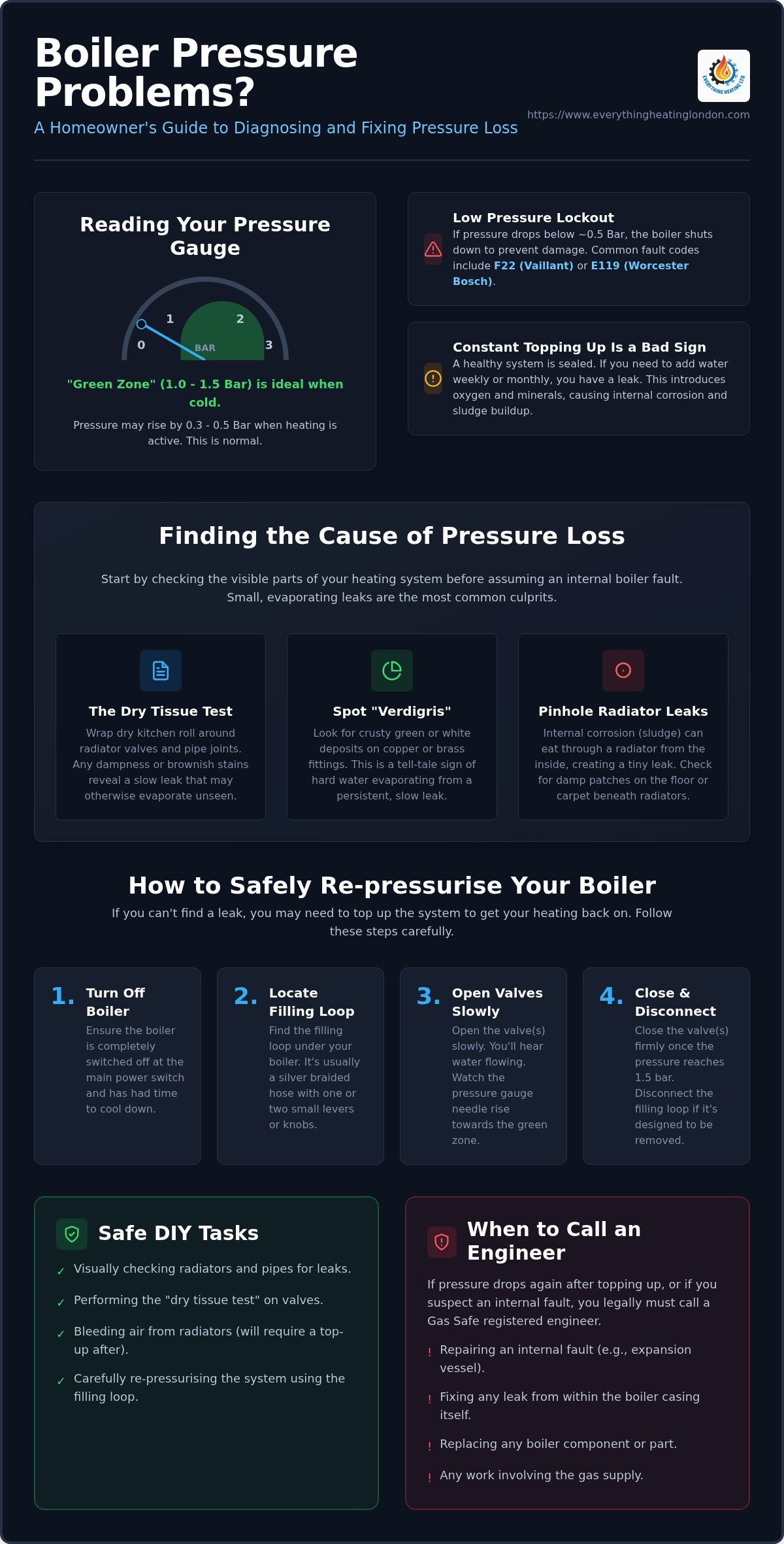
Most modern boilers feature a pressure gauge on the front panel, often highlighted with a green section between 1.0 and 1.5 bar. This is the ideal range when your heating is cold. You might notice that the pressure rises slightly whilst the heating is active. This is normal. Water expands when it gets hot, so a small climb of 0.3 to 0.5 bar is expected. The needle should settle back to its original position once the radiators cool down. If it stays low or drops to zero, your home won't get the warmth it needs.
How to Read Your Boiler Pressure Gauge
Older boilers typically use a hydraulic gauge with a physical needle. Modern models often use digital displays on an LCD screen. If your boiler stops working, it will likely display a specific fault code. For example, Vaillant boilers often show F22, whilst Worcester Bosch models might display E119. These codes are just the boiler's way of telling you it's thirsty. In domestic plumbing, a "Bar" is a metric unit used to measure the force of water pressure within your pipes.
Why Constant Topping Up is a Warning Sign
A healthy heating system is sealed. It shouldn't lose water under normal conditions. If you find yourself topping up the pressure once a week or even once a month, you have a genuine fault. Regularly adding "fresh" water to your system is actually harmful. New water introduces fresh oxygen and minerals into the pipes. Over time, this leads to internal corrosion and the buildup of magnetite, a black sludge that can block your heat exchanger and radiators. Whilst topping up after bleeding a radiator is fine, doing it frequently suggests a leak or a failing component that needs professional attention.
Visible Leaks and Radiator Issues: The Most Common Culprits
Finding a leak doesn't always require a torch and a magnifying glass. We recommend an "outside-in" approach. This means checking the visible parts of your heating system, like radiators and valves, before assuming the fault lies deep inside the boiler itself. Often, the primary boiler losing pressure cause is a tiny drip from a pipe joint or a radiator valve that has slowly drained the system over several weeks. Because central heating water is often hot, small leaks can evaporate before they ever hit the floor, making them remarkably difficult to spot with the naked eye.
The "dry tissue test" is your best tool here. Take a piece of dry kitchen roll and wrap it tightly around every radiator valve and visible pipe joint. If the paper comes away damp or shows a brownish stain, you've found your culprit. Pay close attention to the floor directly beneath your radiators. In London and Middlesex, the high mineral content in our hard water often leaves behind a tell-tale sign of a leak: verdigris. This is a crusty, green or white deposit that forms when hard water reacts with copper or brass fittings. If you see this "fuzz" on a joint, it's a clear sign that water is escaping.
You might find that a leak only appears when the system is cooling down. Metals expand when hot and contract when cold. A joint that is watertight whilst the heating is running might open up just enough to weep water once the temperature drops. This is why many homeowners wake up to find their pressure has bottomed out overnight.
Leaking Radiator Valves and TRVs
Every radiator has two valves. One is the Thermostatic Radiator Valve (TRV), which you use to adjust the temperature. The other is the lockshield valve, usually covered by a plastic cap. These valves rely on internal rubber O-rings to stay sealed. Over time, these seals perish, especially in older London properties. We often see leaks occur after a room has been decorated. If a radiator was removed and replaced, the compression nuts might not have been tightened correctly, or the old seal might have failed when disturbed. A simple nip with a spanner can sometimes fix this, but be careful not to over-tighten and crack the fitting.
Pinhole Leaks and Hidden Pipework
Internal corrosion is a silent system killer. If your system hasn't been properly treated with inhibitor, sludge can settle at the bottom of a radiator. This sludge eats away at the metal from the inside, eventually creating a microscopic "pinhole" leak. These are particularly tricky because the water often soaks into the carpet or floorboards without being noticed. Investing in professional power flushing is the best way to clear this sludge and stop corrosion before it ruins your radiators. If you've checked every valve and still can't find the leak, it may be hidden under floorboards. If you're struggling to locate the source, our experts can help with a professional boiler repair to get your system back to full health.
Internal Boiler Faults: Expansion Vessels and Relief Valves
If your radiators are bone dry and you're still seeing the needle drop, the issue is almost certainly internal. This is where we look at the expansion vessel. It's a small tank inside your boiler that acts like a lung for your heating. When water heats up, it expands. The vessel provides a cushioned space for that extra volume to go. Without it, the pressure has nowhere to go but up, which puts your entire system at risk. This is a very common boiler losing pressure cause that often goes unnoticed until the heating fails completely.
This leads to what we call the "Bounce" effect. You might notice your gauge hits 3 bar whilst the heating is active. This triggers the Pressure Relief Valve (PRV), a safety device designed to dump water out of a copper pipe on your external wall. It protects the boiler from exploding under high pressure. Once the system cools down and the water contracts, the pressure bottoms out at zero because that excess water was discharged outside. It's a frustrating cycle of topping up only for the boiler to dump the water again an hour later.
There's also the "Silent Leak." A cracked heat exchanger can leak water directly into the condensate trap. Since this pipe is designed to carry away liquid as part of the boiler's normal operation, you'll never see a puddle on the kitchen floor. It's a stealthy boiler losing pressure cause that requires specific diagnostic tools to identify. If you've ruled out every radiator valve, the fault is likely hidden behind the boiler's front cover.
Faulty Expansion Vessel Symptoms
Inside the expansion vessel is a rubber diaphragm. Over time, it can lose its air charge or perish completely. You can try a simple "tap test." Tap the top and bottom of the vessel; one side should sound hollow, whilst the other should sound like a dull thud. If both sides sound solid, the vessel is likely waterlogged. Fixing this involves using a high-pressure pump to reset the air side of the tank. Because it requires opening the boiler casing, it's a task that must be handled by a local heating engineer in Middlesex to ensure the gas seals remain intact.
The Pressure Relief Valve (PRV) Failure
The PRV is your boiler's last line of defence. Once it has been forced open by a pressure spike, it often fails to close properly. This is usually because a tiny bit of grit or limescale gets trapped in the seal, preventing it from seating correctly. You can confirm this with the "bag test." Tie a small plastic bag over the end of the copper discharge pipe outside your house. If the bag collects even a small amount of water over 24 hours, the valve is weeping. Usually, once a PRV starts leaking, it needs to be replaced to restore a reliable seal and stop the constant pressure loss.
Step-by-Step: How to Safely Re-pressurise Your Boiler
If you've investigated every radiator and valve without finding a visible boiler losing pressure cause, it's time to restore the system's balance. Re-pressurising your boiler is a straightforward task. However, it requires a methodical approach to avoid damaging the internal components. Before you start, you must identify your filling loop. Most older systems use an external braided hose. Modern boilers often feature internal keyed or keyless links located directly underneath the unit. These are designed for quick, tool-free topping up.
Safety is paramount. Always switch your boiler off at the mains and allow the system to cool completely before adding water. Cold water entering a hot heat exchanger can cause metal fatigue or even cracks. Once the system is cool, follow these five steps to add water safely:
- Locate your filling loop and ensure all connections are tight.
- Open the first valve fully (if your loop has two).
- Slowly open the second valve whilst watching the pressure gauge.
- Close both valves firmly once the needle reaches 1.2 to 1.5 bar.
- Disconnect the filling loop if it is an external type to comply with water regulations.
Using an External Braided Filling Loop
If your system uses a silver, braided hose, ensure both ends are securely screwed onto the brass valves. You'll usually find these pipes beneath the boiler or near the hot water cylinder. Open the valves slowly. You should hear the sound of rushing water immediately. Keep a close eye on the gauge. It often moves faster than you might expect. Once the needle sits comfortably in the green zone, close the valves tightly. If the hose is a temporary attachment, remove it now to prevent accidental over-filling later.
Common Mistakes to Avoid
A common error is leaving the filling loop valves slightly open. This causes the pressure to rise indefinitely, eventually forcing the PRV to discharge water outside. If you accidentally add too much water and the gauge hits 2.5 or 3 bar, don't panic. You can lower the pressure by bleeding a radiator into a bucket. You should always bleed your radiators after topping up the system to remove any air pockets introduced during the process. If you find the pressure drops again within hours, re-pressurising is no longer a solution. You need a professional boiler repair to find the underlying fault and protect your home from water damage.
When to Call a Gas Safe Engineer in London
Knowing the boundary between a simple DIY top-up and a legal requirement is vital for every homeowner. In Great Britain, the Gas Safety (Installation and Use) Regulations 1998 are very clear. You are perfectly entitled to bleed a radiator or use a filling loop to add water. However, you must never remove the boiler casing yourself. This is the legal limit. Any task that requires access to the internal components must be performed by a Gas Safe registered engineer. This isn't just about red tape. It's about your safety. Opening a boiler can disturb gas seals or combustion settings, which creates a genuine risk of carbon monoxide leaks.
If your pressure keeps dropping after you've checked every radiator valve, the boiler losing pressure cause is likely hidden from view. A professional has the diagnostic tools to find what you cannot see. Whilst you might spend hours searching for a damp patch, an expert can isolate the boiler from the rest of the system to prove exactly where the water is going. This methodical approach saves you time and prevents the frustration of replacing parts that aren't actually broken.
The Diagnostic Process
Our engineers don't rely on guesswork. We use precision pressure testing gauges to monitor the system in sections. This allows us to determine if the leak is tucked away inside the boiler or buried deep under your floorboards. In complex cases, we use thermal imaging cameras. These devices show the heat signature of escaping water behind walls or under carpets without the need to tear up your flooring. At Everything Heating Ltd, we prioritises transparency. We'll explain the fault in plain English and provide a clear breakdown of the repair work required before we start.
London Hard Water and System Health
London and Middlesex are known for having particularly hard water. This mineral-heavy water is a frequent boiler losing pressure cause because it creates limescale buildup. Limescale can jam your Pressure Relief Valve (PRV) or cause the expansion vessel to perish prematurely. Regular annual boiler servicing is the most effective way to catch these issues before they turn into a mid-winter emergency. During a service, we check the air charge in your expansion vessel and ensure all safety valves are seating correctly.
If your system is full of black sludge, a power flush can clear the debris that causes pressure fluctuations. We also recommend fitting a magnetic system filter to catch metallic particles before they damage your pump. If your boiler is reaching the end of its life and repairs are becoming frequent, it may be more cost-effective to consider a new boiler installation in West London. Modern A-rated units are far more resilient and can significantly lower your energy bills.
Need a straight-talking expert to get your heating back on track? Book a boiler repair with Everything Heating Ltd today.
Restore Your Home's Warmth and Efficiency
Dealing with a cold home is stressful, but most pressure issues are manageable once you know where to look. By following an "outside-in" approach, you can often spot a simple leak or use a filling loop to get your heating back online. However, if you find yourself topping up the water every few days, it's a clear sign of an underlying boiler losing pressure cause that needs an expert eye. Whether it's a perished expansion vessel or a weeping safety valve, ignoring the problem only leads to higher bills and potential system damage.
Everything Heating Ltd provides a team of Gas Safe registered engineers across the capital. We are London-based specialists who value transparent pricing and honest advice above all else. We don't do corporate fluff; we just provide the clear, reliable service your home deserves. Get a Straight-Talking Boiler Repair Quote in London today and enjoy the peace of mind that comes with a perfectly balanced heating system. You don't have to face the winter with a temperamental boiler. We're here to help you get things back to normal.
Frequently Asked Questions
Is it safe to use a boiler with low pressure?
Yes, it is generally safe, but your boiler won't work effectively. Most modern systems are designed to shut down or "lockout" if the pressure drops below a certain level, usually 0.5 bar. This safety feature prevents the pump from running dry, which could cause expensive internal damage. Whilst it isn't dangerous like a gas leak, you won't have heating or hot water until you identify the boiler losing pressure cause and top it up.
How much does it cost to fix a boiler losing pressure in London?
The cost depends entirely on the underlying fault. A simple task like tightening a radiator valve or re-pressurising an expansion vessel is relatively inexpensive. However, replacing major components like a heat exchanger or a diverter valve will be more costly. In London, hourly rates for Gas Safe engineers typically reflect the local market. We always provide a clear, transparent breakdown of costs before starting any repair work to ensure there are no surprises for our customers.
Can a faulty expansion vessel cause my boiler to leak water?
Yes, a faulty expansion vessel is a very common reason for water leaks. When the internal diaphragm fails, the vessel fills with water and can no longer absorb the expansion of heated water. This causes the pressure to spike rapidly, which forces the Pressure Relief Valve to open. You might see water dripping from the copper discharge pipe on your external wall. This "silent leak" is a classic boiler losing pressure cause that requires professional attention.
Why does my boiler pressure go up when the heating is on but down when it is off?
It is normal for pressure to rise slightly, usually by 0.3 to 0.5 bar, when the water gets hot. This is simple physics. However, if the needle swings wildly from 1 bar when cold to over 3 bar when hot, your expansion vessel has likely failed. When the water cools and contracts, the pressure will drop back down. If the safety valve was triggered during the peak, the pressure might even drop to zero once the system is cold.
Do I need to bleed my radiators if my boiler pressure is low?
You should only bleed your radiators if they have cold spots at the top, which indicates trapped air. Bleeding a radiator actually removes water from the system, which will cause your boiler pressure to drop even further. If your pressure is already low, you must top it up using the filling loop first. Once the system is at the correct level, you can bleed the radiators and then top it up again if the needle has moved.
How often should I have to top up my boiler pressure?
In a perfectly healthy, sealed system, you shouldn't have to top up the pressure at all. It's normal to add a little water once or twice a year, perhaps after you've bled the radiators or had a summer break. If you find yourself reaching for the filling loop every few weeks or months, you have a leak. Frequent topping up introduces fresh oxygen into your pipes, which accelerates internal corrosion and the buildup of damaging sludge.
What happens if I over-pressurise my boiler system?
Over-pressurising usually happens if you leave the filling loop open for too long. If the gauge goes above 3 bar, the Pressure Relief Valve will likely trigger to dump the excess water outside. To fix this yourself, simply bleed one of your radiators into a bucket whilst the boiler is off. Watch the gauge carefully as you do this. Once the needle returns to the 1.2 to 1.5 bar range, close the radiator valve firmly and check the gauge again.
Can a leaking heat exchanger be repaired or does the boiler need replacing?
A leaking heat exchanger is a serious fault that usually requires the entire component to be replaced. Because the heat exchanger is one of the most expensive parts of a boiler, the repair cost can be high. If your boiler is more than ten years old, we often recommend a new boiler installation instead. When a repair costs more than 50% of the price of a new, energy-efficient unit, replacing the boiler is usually the smarter financial choice.


