

One in six homes in the UK currently contains an unsafe gas appliance. It's a sobering thought for any property owner, especially with the Renters' Rights Act 2025 now in full force. We know that managing your landlord gas safety certificate landlord UK obligations can feel like chasing a moving target. Between coordinating access with busy tenants and tracking the latest HHSRS hazard ratings, the administrative burden is heavy. You want to keep your residents safe and your business compliant without the constant fear of a £7,000 fine hanging over your head.
This 2026 guide simplifies everything you need to know about gas safety compliance. We'll explain how to navigate the new Private Rented Sector database launching this December and ensure your CP12 inspections are handled with zero fuss. From the streets of Greenford to the heart of Uxbridge, we'll show you how to secure a reliable local engineer who handles the heavy lifting. You'll learn the exact steps to achieve total legal peace of mind while keeping your tenants happy and your properties secure.
Key Takeaways
- Learn your essential legal duties under the 1998 regulations to protect your tenants and avoid significant non-compliance fines.
- Discover the most efficient way to secure the landlord gas safety certificate landlord UK property owners need to remain compliant in 2026.
- Understand the specific inspection codes used by Gas Safe engineers and what immediate actions are required if an appliance fails a safety check.
- Find out how to manage your compliance timeline effectively, including the 28-day rule for providing digital records to your tenants.
- See why combining your CP12 inspection with an annual boiler service provides the best value and peace of mind for landlords in West London and Middlesex.
Understanding the Landlord Gas Safety Certificate: Legal Requirements in 2026
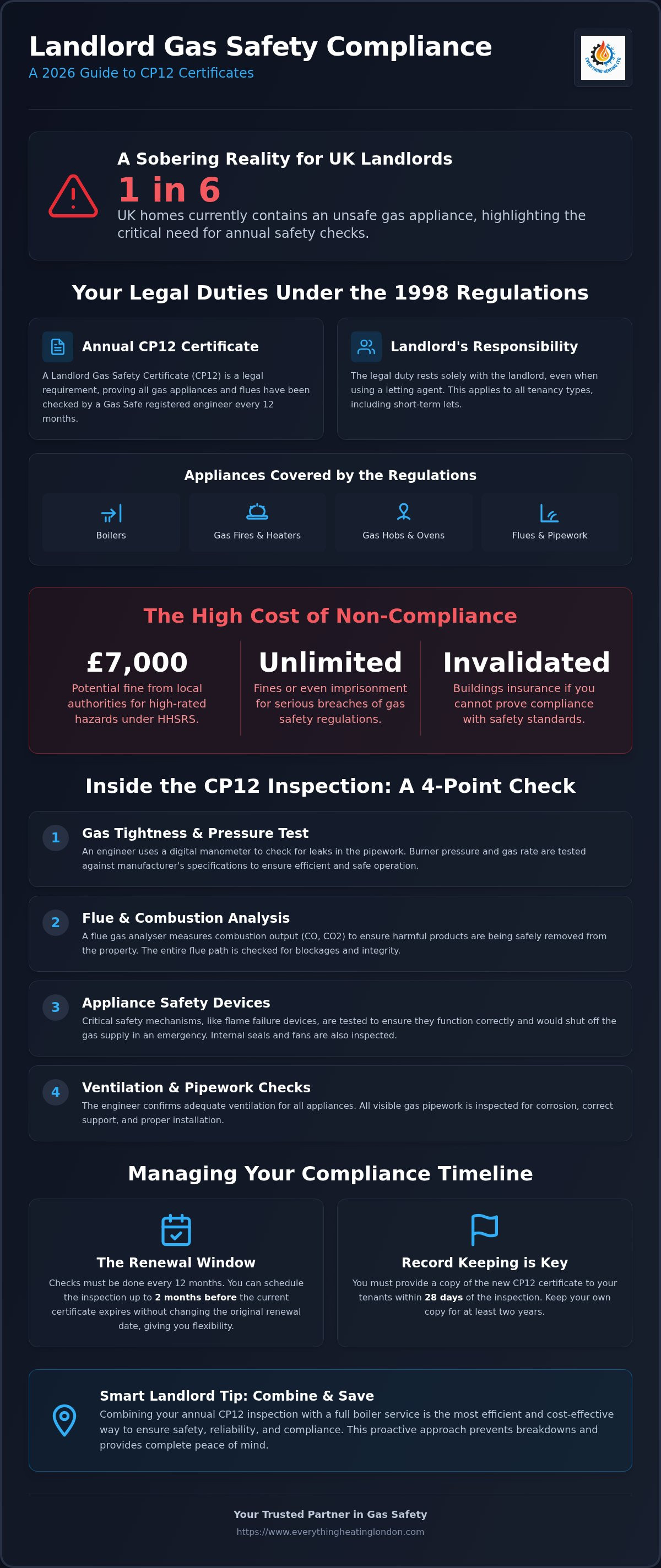
A Landlord Gas Safety Certificate, frequently referred to as a CP12, is a legal record confirming that your property's gas appliances and flues have been checked for safety. It isn't just a piece of paper; it's a vital part of your risk management. Under the Gas Safety (Installation and Use) Regulations 1998, every landlord in the UK must ensure that gas fittings and appliances are maintained in a safe condition. This law applies to almost all residential properties, including those in Greenford and Uxbridge, where gas is present.
The legislation covers all gas appliances you provide for your tenants, including:
- Central heating boilers
- Gas fires and heaters
- Gas hobs and ovens
- Flues and pipework
If you fail to provide a valid landlord gas safety certificate landlord UK authorities can take severe action. Since the HHSRS updates in June 2026, local authorities can issue fines of up to £7,000 for high-rated hazards. Beyond the financial hit, serious breaches can lead to unlimited fines or even imprisonment. Your buildings insurance may also be invalidated if you cannot prove your property meets these safety standards. It's about protecting your investment as much as your residents.
Who Is Responsible for Gas Safety?
The legal duty rests squarely on the landlord's shoulders. Even if you use a letting agent, you are ultimately responsible for ensuring the annual check happens. This applies to traditional long-term tenancies, short-term lets, and Airbnb hosts operating within London. While tenants are responsible for their own appliances, like a gas cooker they brought with them, you are still responsible for the safety of the pipework connecting those appliances. You must only ever use a Gas Safe registered engineer to carry out this work. It’s the only legal way to obtain a valid certificate.
The 12-Month Rule and Renewal Windows
Compliance is a continuous cycle. You must have your gas safety check carried out every 12 months. Waiting until the final week often leads to stress, especially if coordinating access with tenants proves difficult. The "check-and-stay" rule is designed to help you stay ahead. It allows you to organise the inspection up to two months before the current certificate expires whilst keeping the original renewal date. The CP12 renewal window allows you to complete the safety check between 10 and 12 months after the previous one without shortening the lifespan of your current certificate.
Inside the CP12 Inspection: What Our Engineers Actually Check
When an engineer arrives to issue a landlord gas safety certificate landlord UK property owners often wonder what actually happens behind the boiler casing. It isn't just a quick visual glance. It's a systematic technical verification of the entire gas installation. We follow a methodical process to ensure every component functions as the manufacturer intended, removing the guesswork from property maintenance. This level of detail is what provides genuine peace of mind for you and your tenants.
The inspection begins with a gas tightness test. We use a digital manometer to monitor the pressure in your system. If the pressure drops, it indicates a leak in the pipework that needs immediate attention. We then move on to checking the burner pressure and gas rate. By comparing these readings against the appliance's data plate, we can tell if it's burning too much or too little gas. Both scenarios can be dangerous or lead to premature appliance failure. We also use a flue gas analyser to measure the levels of oxygen, carbon monoxide, and carbon dioxide. This ensures the combustion process is clean and efficient.
Testing the flue performance is another critical step. We verify that all combustion products are being safely removed from the property. Following the official HSE guidance for landlords, our engineers check that flue terminals are clear and that the flue itself is securely joined and correctly supported throughout its length.
Appliance-Specific Safety Tests
Each appliance has its own set of requirements. For boilers, we focus on internal seals, fans, and safety devices like the flame failure device. Gas cookers and fires require us to check for stability and adequate ventilation in the room. Even the pipework gets a thorough look. We check all accessible pipes for signs of corrosion or poor support. These often-overlooked details are what prevent minor issues from becoming major emergencies. Our reliable gas safety inspections provide a clear picture of your property's health without any jargon.
Carbon Monoxide Safety and Ventilation
Ventilation is the most effective way to prevent Carbon Monoxide (CO) buildup. We ensure that air bricks, vents, and chimneys are free from obstructions. We also test CO alarms to confirm they meet current UK standards and are positioned correctly. If an appliance fails, we categorise the fault. An "At Risk" (AR) appliance is unsafe and should be isolated. An "Immediately Dangerous" (ID) appliance poses a direct threat to life and must be capped off immediately. This transparent classification helps you understand exactly what repairs are needed to stay compliant.
Managing Your Gas Safety Timeline: Renewals and Tenant Access
Compliance is about more than just the physical check. It’s also about the trail of paperwork you leave behind. You are legally required to keep a record of every gas safety check for at least two years. This helps you prove your history of compliance if a local authority ever requests it. Maintaining a current landlord gas safety certificate landlord UK record is a non-negotiable part of property management. You must provide a copy of this record to existing tenants within 28 days of the inspection. For new tenancies, the rules are even stricter. You must give the tenant a copy before they move in. In 2026, digital certificates are the standard. They are easier to store, harder to lose, and acceptable to all major regulatory bodies. If you are curious about budgeting for these checks, our Landlord Gas Safety Certificate Cost guide provides a clear breakdown of current pricing.
Navigating Tenant Access Issues
Securing access to a property is often the biggest hurdle for landlords. Start by giving your tenants plenty of notice. A minimum of 24 hours is required, but a week’s notice is often better for maintaining a good relationship. If a tenant refuses access, don't panic. You must show that you took all reasonable steps to comply. This means documenting every email, letter, and phone call. The official HSE guidance on gas safety suggests that keeping these records is your best defence if you are ever questioned about a late inspection. We find that a friendly, straight-talking approach usually works best.
Combining CP12 with Annual Maintenance
Smart landlords look for ways to streamline their property management. It makes perfect sense to organise an annual boiler service at the same time as your CP12 inspection. Grouping these tasks reduces disruption for your tenants because they only need to wait in for one visit. It also saves you time on administration. Regular servicing is the best way to ensure your appliances pass the gas safety check. A well-maintained boiler is far less likely to have the kind of leaks or combustion issues that lead to a failed certificate. It’s a proactive way to keep your property running smoothly and your tenants happy.
Handling a Failed Gas Safety Inspection: Repairs and Compliance
Discovering your property has failed its inspection is stressful. We understand the pressure to get your landlord gas safety certificate landlord UK status back to compliant as quickly as possible. When our engineers find a fault, they use specific industry codes to explain the severity of the issue. An "Immediately Dangerous" (ID) classification means the appliance is a direct threat to life. In these cases, the engineer has a legal duty to cap off the gas supply to that specific appliance. An "At Risk" (AR) classification means the appliance has a fault that makes it unsafe, even if it doesn't pose an immediate life threat.
It's vital to distinguish between a safety fail and a maintenance recommendation. A recommendation is simply professional advice to improve efficiency or prevent future breakdowns. It won't prevent you from getting your certificate. However, ignoring AR or ID faults will stop your compliance in its tracks. We prioritise transparency. You'll always get a straight-talking explanation of why a repair is necessary and what it will take to fix it. We don't believe in hidden extras or complicated jargon.
Immediate Dangerous (ID) Situations
If we identify an ID situation, we must disconnect the appliance for safety. This often leaves tenants without heating or hot water. As a landlord, you have a duty of care to provide alternative facilities, such as electric heaters or hobs, whilst repairs are organised. We specialise in fast-tracking boiler repairs in London to restore service as quickly as possible. Our engineers carry common spare parts to resolve issues on the spot whenever feasible, reducing the time your tenants are without essential services.
At Risk (AR) Classifications
At Risk classifications require prompt action. While the danger isn't immediate, the appliance is still legally unsafe to use. Common AR failures include inadequate ventilation in the room or minor issues with how the flue is supported. Addressing these promptly balances repair costs with long-term system reliability. It's often much cheaper to fix a minor ventilation issue now than to deal with the consequences of a complete system failure later. We help you navigate these choices with practical, honest advice that respects your budget.
If your property needs urgent attention to meet compliance standards, book a priority repair visit with our Gas Safe team today to get your certificate sorted.
Professional CP12 Certification in London: The Everything Heating Approach
Choosing a local specialist for your landlord gas safety certificate landlord UK requirements makes a tangible difference to your property management. National call centres often struggle with the nuances of London’s housing stock and the logistical challenges of West London traffic. We focus our expertise on West London and Middlesex, covering areas like Greenford and Uxbridge with a level of care that larger firms simply can't match. You aren't just another number in a database; you're a local property owner who needs reliable, straight-talking advice. Our engineers live and work in these communities. They understand the local infrastructure and the common issues found in properties across the region. Finding a Local Heating Engineer Middlesex landlords can trust is the first step toward a stress-free compliance year. This local focus allows us to be more responsive and provide a more personal touch than a faceless national brand.
Why Choose Everything Heating for Your Portfolio?
We've built our service around the needs of busy landlords and letting agents who don't have time for complicated admin. Our booking process is streamlined and modern, utilising a tech-enabled flow that respects your schedule. You won't find any hidden extras, surprise fees, or corporate fluff here. Our Gas Safe registered engineers arrive on time, act professionally, and treat your tenants’ homes with genuine respect. We focus on providing peace of mind through total transparency. Once the inspection is complete, we deliver a detailed digital report promptly to your inbox. These reports are designed to be easy to understand. They provide a clear, unambiguous record of your property's safety status, making it simple to share with tenants or store in your digital compliance folder.
Preparing for Your Inspection
A little preparation goes a long way in ensuring a smooth inspection and keeping your costs down. Before our engineer arrives, please check that we have clear access to the gas meter and all gas appliances in the property. This includes moving any furniture, boxes, or storage items that might be blocking the way. If your property uses a pre-payment meter, please ensure it has enough credit for the engineer to test the appliances under full load. We also recommend letting your tenants know exactly when we are coming to avoid any confusion at the door. Following this simple checklist helps us complete the work efficiently and reduces the need for follow-up visits. To get your property ready for the year ahead, you can contact Everything Heating to book your 2026 certificate and experience our no-nonsense approach to gas safety.
Securing Your Property and Compliance for 2026
Navigating the evolving landscape of gas safety doesn't have to be a source of stress. By staying ahead of the 12-month renewal window and maintaining digital records, you protect both your tenants and your investment. The introduction of the PRS database this December makes consistent compliance more visible than ever. Securing a landlord gas safety certificate landlord UK property owners can rely on is about finding a partner who values transparency as much as you do.
Our team of Gas Safe Registered Engineers provides the calm competence you need to manage your portfolio across Greenford and Uxbridge. We are specialists in London property compliance, offering a straight-talking, reliable service that cuts through the jargon. We handle the technical checks so you can focus on running your business with total peace of mind. Don't leave your legal obligations to chance or wait for a failed inspection to take action.
Take the first step toward a safer property today. Book your Landlord Gas Safety Certificate with Everything Heating today and experience a modern, efficient approach to property maintenance. We're here to help you keep your residents safe and your business fully compliant.
Frequently Asked Questions
How much does a landlord gas safety certificate cost in 2026?
Pricing for a landlord gas safety certificate landlord UK property owners require varies based on the number of appliances in the home. A standard check typically covers the gas meter and the primary boiler, while additional items like gas fires or hobs usually incur a small extra fee. You should always request a clear quote from a Gas Safe registered engineer before booking to ensure there are no hidden charges for your specific setup.
Is a gas safety certificate a legal requirement for all landlords?
Yes, it's a strict legal requirement for all landlords under the Gas Safety (Installation and Use) Regulations 1998. This duty applies if your property has any gas appliances, even if the tenant provides their own. Failing to maintain a valid certificate can lead to unlimited fines or imprisonment. It remains a critical compliance document even after the Renters' Rights Act 2025 changed how possession notices work earlier this year.
Can I get a gas safety certificate if I have a smart meter?
You can absolutely obtain a certificate if your property has a smart meter installed. The meter itself is simply a way of measuring usage and doesn't interfere with the safety inspection of your boiler, pipework, or flues. Our engineers are familiar with all types of metering equipment across London and Middlesex. They'll ensure the gas tightness test is performed correctly regardless of the meter technology used in the home.
How long does a gas safety inspection take to complete?
A professional gas safety inspection typically takes between 30 and 60 minutes to complete. The exact duration depends on the size of the property and how many gas appliances need testing. A simple boiler-only check is faster than a property with multiple gas fires and a kitchen range. We recommend allowing an hour for the visit to ensure our engineer can carry out a thorough, unhurried assessment of every safety device.
What happens if my tenant refuses to let the gas engineer in?
If a tenant refuses access, you must demonstrate that you took all reasonable steps to carry out the check. This involves keeping a detailed log of your attempts to communicate, including letters, emails, and phone calls. Usually, a calm conversation explaining that the check is for their own safety resolves the issue. If they continue to block access, you may need to seek legal advice to fulfill your statutory safety duties and protect your residents.
Do I need a gas safety certificate for an electric-only property?
No, you don't need a Gas Safety Certificate (CP12) for a property that is entirely electric with no gas supply. however, if there is a gas meter at the property, even if it's capped off or not in use, it's often wise to have a professional verify that the system is safe. For electric properties, you should focus on your Electrical Condition Report (EICR) to remain compliant with UK rental laws.
Can I carry out my own gas safety check if I am competent?
You cannot legally carry out your own gas safety check unless you are currently on the Gas Safe Register. Being "handy" or "competent" is not enough to meet the legal standard required for a landlord gas safety certificate landlord UK residents depend on. The law is very clear that only registered professionals have the training and authority to issue a valid CP12. Using an unregistered person is a criminal offence for both parties.
How often do I need to renew my CP12 certificate?
You must renew your certificate every 12 months. To make this easier, you can take advantage of the "check-and-stay" window. This allows you to have the inspection done up to two months before your current certificate expires whilst keeping the original expiry date for the following year. It’s a practical way to stay compliant without losing days of coverage or rushing at the last minute to find a reliable local engineer.


