

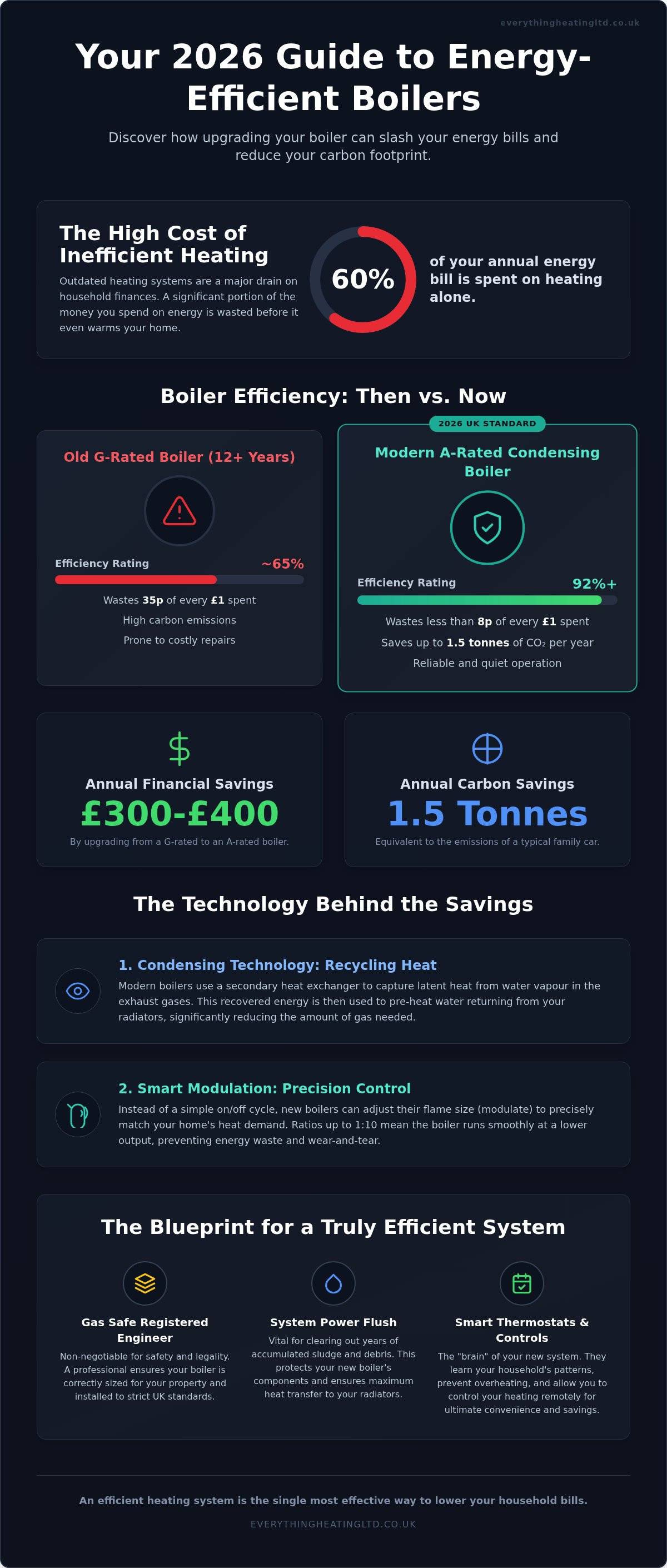
Heating accounts for roughly 60% of your annual energy bills. That is a massive chunk of your household budget going straight into your radiators. If you're staring at your monthly statement and wondering why it's so high, you're likely dealing with an outdated, inefficient system. Investing in an energy efficient boiler installation is the most effective way to reclaim control over your costs and keep your home warm.
It's frustrating to face a wall of technical jargon like ErP ratings and modulation when you just want a reliable boiler. We understand that. By replacing an old G-rated unit with a modern A-rated condensing model, you could save between £300 and £400 every year. This process isn't just about a new box on the wall; it's about making your home more comfortable and significantly reducing your carbon footprint.
This guide cuts through the noise to give you clear, honest advice for 2026. You'll discover how to choose the right size for your property and stay on the right side of UK gas regulations. We will explain why Gas Safe registration is non-negotiable and how smart controls can act as the brain of your new, high-performance heating system.
Key Takeaways
- Learn how modern condensing technology recycles heat to cut your annual energy bills by up to £400.
- Understand the legal standards for an energy efficient boiler installation in 2026, including mandatory efficiency ratings and controls.
- Discover why a power flush is vital to clear out system sludge and protect your new boiler's internal components.
- Find out how smart thermostats and modulation ratios work together to stop your home from overheating and wasting fuel.
- Recognise the importance of using a Gas Safe registered professional to ensure your system is sized correctly and installed safely.
What is an Energy Efficient Boiler Installation?
An energy efficient boiler installation is a complete system upgrade designed to squeeze every bit of heat out of the gas you pay for. It isn't just about hanging a new white box on the wall. It involves setting up a system that captures and reuses heat that older units simply threw away. In 2026, UK standards are strict. Every new gas boiler must hit at least 92% efficiency. When you consider that heating accounts for roughly 60% of a typical UK household's energy spend, that efficiency jump is the fastest way to lower your monthly outgoings.
The core of this efficiency is condensing technology. Older boilers lost a massive amount of energy through the flue pipe in the form of hot exhaust gases. Modern systems use a secondary heat exchanger to trap this latent heat from water vapour before it escapes. To get a deeper technical look, you can read about how condensing boilers work to recycle this energy. By the time the exhaust leaves your home, it's much cooler because the heat is already back in your radiators.
We often talk about unit efficiency versus installed system efficiency. A boiler might be rated for 94% efficiency in a lab, but if it's connected to a sludge-filled system or sized incorrectly for your home, it won't perform. True efficiency requires a clean system, the right controls, and a professional who understands the specific layouts of London properties. A professional energy efficient boiler installation ensures the unit is tuned to your home's specific needs rather than just running at a factory default setting.
The ErP Rating System Explained
The Energy-related Products (ErP) rating is your primary tool for comparing appliances. It uses a simple A to G scale, similar to what you see on a new fridge or washing machine. Almost every modern boiler you can buy today is A-rated, meaning it operates at 90% efficiency or higher. However, you should also check the standby energy consumption. This is the small amount of power the boiler uses when it's not actively heating your water. Over a year, these small numbers add up, so look for models with the lowest standby losses to maximise your savings.
Why 2026 is the Year to Upgrade
If your current boiler is more than 12 years old, it's likely a G-rated model operating at around 65% efficiency. You're effectively wasting 35p of every pound you spend on gas. With energy prices remaining a top concern for UK homeowners, the financial tipping point has shifted. It's often cheaper to replace an ageing unit than to pay for recurring repairs and inflated fuel bills. Upgrading now also aligns your home with the UK's net-zero targets. A single A-rated boiler can save up to 1.5 tonnes of CO2 per year, making your home greener and cheaper to run simultaneously.
How Modern Condensing Boilers Maximise Heat
Modern boilers are significantly more advanced than the units installed just a decade ago. An old G-rated boiler typically operates at only 60% to 70% efficiency. This means for every pound you spend on gas, 30p or 40p is literally disappearing out of the flue pipe. A professional energy efficient boiler installation changes this dynamic by using every available scrap of energy. The secret lies in two main areas: how the boiler captures heat and how it manages its own power output.
The Secondary Heat Exchanger
The secondary heat exchanger is the engine room of efficiency. In older systems, the hot exhaust gases from combustion were simply vented outside. Modern condensing boilers use a second exchanger to capture the "latent heat" from the water vapour in those gases. By cooling the vapour until it turns back into liquid water, known as condensate, the boiler recovers energy that would otherwise be lost. Stainless steel exchangers are the gold standard here. They resist the acidic nature of the condensate better than aluminium, ensuring your boiler doesn't lose its efficiency over time. This level of engineering is why ENERGY STAR certified boilers are recognised globally for their ability to lower running costs while maintaining a high output.
Modulation: The Secret to Lower Bills
Modulation is another massive leap forward in heating technology. Most people assume a boiler is either on or off, but that "all or nothing" approach is incredibly wasteful. It leads to "cycling," where the boiler fires up, gets too hot, shuts down, and then repeats the process minutes later. Modern boilers have high modulation ratios, sometimes as high as 1:10. This allows the boiler to "turn down" its flame to match the exact heat demand of your home at any given moment. It's a much smoother way to operate.
Think of it like driving a car. If you drove by flooring the accelerator and then slamming on the brakes every few seconds, your fuel economy would be terrible. That is exactly what an old boiler does. A modern unit is like a car using cruise control on the motorway. It finds the most efficient speed to maintain a steady temperature and stays there. This steady state uses far less gas and puts significantly less strain on the internal components, extending the life of the unit.
You can actually see this efficiency in action through a process called "pluming." That white, steam-like cloud you see coming from modern flues on a cold day is a good sign. It shows that the exhaust gases are cool because the heat has been successfully stripped out and sent to your radiators. If you're tired of seeing your money disappear in invisible, hot exhaust, it might be time for an energy efficient boiler installation consultation to upgrade your home's performance and comfort.
Comparing Boiler Types for Efficiency and Performance
Choosing the right hardware is just as critical as the technology inside. Every home has a unique "heat profile" based on its size, insulation, and how many people live there. An energy efficient boiler installation must be tailored to these specific needs. If the unit is too small, your home stays cold. If it's too large, the boiler will never reach its peak efficiency. In London, where housing ranges from compact studio flats to sprawling multi-storey townhouses, the choice between a combi, system, or regular boiler is the first big decision you will face.
Combi Boilers: Instant Heat Efficiency
Combination (combi) boilers are the most popular choice for London homes. They act as both a high-efficiency water heater and a central heating boiler in a single compact unit. Because they heat water directly from the mains when you turn on a tap, you don't need a bulky hot water cylinder or a cold water tank in the loft. This saves a massive amount of space. More importantly, it eliminates "standby heat loss." You aren't paying to keep a large tank of water hot all day while you are at work. However, combis have limits. If you have three bathrooms all in use at once, the water pressure will likely drop. They are best suited for properties with one or two bathrooms.
System Boilers and Modern Unvented Cylinders
For larger households, a system boiler is often the superior choice. These boilers work alongside a separate hot water cylinder. Modern unvented cylinders are a world away from the copper tanks of the past. They are heavily insulated, often keeping water hot for more than 24 hours with minimal temperature loss. This setup allows for high flow rates to multiple taps simultaneously. It's the ideal solution for multi-storey London homes where family members might be showering in different rooms at the same time. These systems also integrate perfectly with smart zone controls, allowing you to heat the ground floor whilst keeping the bedrooms cool, further boosting your overall efficiency.
You might also encounter "regular" or vent-only boilers. These are common in older properties and use two tanks in the loft to feed the system. While you can replace these like-for-like, we often recommend upgrading to a sealed system. This removes the "open" tanks which can collect dust or freeze in winter. It also allows for higher system pressure, which means your radiators will heat up faster and more evenly.
One final word of caution: avoid the "bigger is better" trap. Some installers might suggest a 40kW boiler for a small flat "just to be safe." This is poor advice. As we discussed in the previous section, a boiler that is too powerful cannot modulate down effectively. It will cycle on and off constantly, wasting gas and wearing out the internal parts. A professional installation involves a precise heat loss calculation to ensure the boiler is the perfect size for your specific radiators and rooms.
Optimising Your System: Controls and Cleansing
A high-quality boiler is just one piece of the puzzle. An energy efficient boiler installation must consider the health of the entire pipework and radiator network. If you ignore the state of your existing system, you are essentially throwing money away. New boilers have narrower waterways in their heat exchangers. They are designed for precision; they aren't built for pumping around years of accumulated debris. Putting a modern boiler on a dirty system is a guaranteed way to see your efficiency plummet and your repair bills climb.
The Necessity of Power Flushing
Over time, the inside of your radiators and pipes corrodes. This creates a black, metallic mud known as magnetite or "sludge." This substance settles at the bottom of radiators, creating cold spots and forcing your boiler to work harder to reach the desired temperature. It acts as an insulator, effectively blocking the heat from reaching your rooms. This means you pay for gas that never actually warms your home.
We perform a deep system cleanse as part of our process to ensure your new investment is protected. Power flushing can improve efficiency by up to 15%. By removing this debris before the new unit is commissioned, we ensure the heat moves freely from the boiler to your living space. We also install magnetic filters. These devices sit on your return pipework and catch any future debris before it can enter and damage your new heat exchanger. It's a simple, no-nonsense way to keep the system running like new for years.
Smart Controls: The Brain of Your Boiler
A basic timer is a blunt instrument. It tells the boiler to turn on at 7 am regardless of whether it is a mild spring morning or a freezing January dawn. Smart thermostats are the brain of a modern home. They learn how long your house takes to heat up and cool down. They use this data to fire the boiler only when necessary, preventing the "overheating" that accounts for so much wasted energy in UK homes.
You should also look for weather compensation. This involves a small sensor outside your home that talks to the boiler. If the temperature outside rises, the boiler automatically lowers its flow temperature. It doesn't need to work as hard because the heat loss from your home has decreased. These intelligent adjustments mean smart controls can often pay for themselves within the first two years of use. To get the most out of these technologies, you need a professional who knows how to configure them correctly. You can book a power flushing or smart thermostat installation with our team to start modernising your home's efficiency today.
Finally, check your Thermostatic Radiator Valves (TRVs). These allow for zonal heating. There is no point in heating a guest bedroom to 21 degrees if no one is using it. By setting individual temperatures for each room, you ensure the boiler only produces the exact amount of energy required. This keeps your home comfortable without burning unnecessary fuel.
Professional Installation with Everything Heating Ltd
An energy efficient boiler installation is only as good as the engineer who fits it. You can buy the most expensive A-rated unit on the market, but if it is configured incorrectly, you will never see the promised savings on your energy bills. We take a different approach. Our team focuses on technical excellence and transparency. We don't hide behind confusing acronyms. Instead, we give you the straight facts about what your home needs to stay warm and efficient.
Every engineer we send to your home is Gas Safe registered. This is the absolute minimum requirement for any London installer. It is your guarantee that the work is legal and meets the stringent safety standards required in the UK. Beyond safety, we focus on precision. We don't just swap one box for another. We look at your entire system to ensure the new boiler is perfectly matched to your radiators and hot water demand.
Our sizing process is bespoke. As we mentioned earlier, over-sizing a boiler is a common mistake that kills efficiency. We perform detailed heat loss calculations for your specific property. This ensures your boiler can modulate effectively, running at a lower, more consistent power level rather than constantly switching on and off. This attention to detail protects your investment and keeps your running costs as low as possible.
Our London Expertise
London housing presents unique plumbing challenges. Whether you live in a Victorian terrace in West London with original narrow pipework or a modern apartment with complex heat interface units, we understand the local infrastructure. We know how to navigate local building regulations and safety standards to ensure your installation is fully compliant.
We prioritise quality workmanship over high-pressure sales tactics. You won't find any "limited time" gimmicks here. We provide honest advice based on years of experience in the capital. Our goal is to build a reliable system that provides peace of mind, not just a quick fix. This means taking the time to ensure every joint is sound and every control is calibrated correctly before we leave your home.
Ensuring Long-Term Efficiency
The job doesn't end when the boiler is on the wall. We complete a full Benchmark commissioning checklist for every installation. This document is vital. It proves that your boiler has been installed and set up according to the manufacturer's exact specifications. It is also a requirement for your warranty to remain valid. We handle the registration of your warranty and notify local building control on your behalf, providing you with all the necessary legal paperwork.
To keep your system running at peak performance, we recommend annual servicing. This prevents small issues from turning into expensive repairs and ensures your efficiency doesn't drift over time. If you are ready to upgrade your home's comfort and start saving on your fuel bills, the next step is simple. Book your survey with Everything Heating Ltd today and get an expert assessment of your home's heating needs.
Upgrade Your Home's Comfort for 2026
Replacing an old boiler is a significant decision. However, the benefits of a modern energy efficient boiler installation are clear. You aren't just buying a new appliance; you're securing lower monthly bills and a more reliable heating system. By combining high-efficiency condensing technology with smart controls and a clean system, you can save up to £400 a year on your fuel costs.
At Everything Heating Ltd, we make the process straightforward. Our Gas Safe registered engineers are specialists in high-efficiency condensing technology. We don't just fit the boiler and leave. We include expert power flushing with every install to protect your new heat exchanger from the start. We believe in honest, straight-talking advice that focuses on what your London home actually needs.
Take the first step towards a warmer, cheaper-to-run home today. You can get a straight-talking quote for your new boiler installation and let our experts handle the technical details. It's time to stop overpaying for heat and start enjoying a more efficient home.
Frequently Asked Questions
How much can I save with an energy efficient boiler installation in 2026?
You can save between £300 and £400 on your annual energy bills by upgrading to a modern A-rated model. These savings are based on replacing an old G-rated boiler in a typical semi-detached home. Since heating accounts for roughly 60% of your household energy spend, an energy efficient boiler installation is one of the most effective ways to reduce your monthly outgoings whilst lowering your carbon footprint.
What is the difference between an A-rated and a G-rated boiler?
The primary difference is the efficiency percentage of the unit. An A-rated boiler operates at 90% efficiency or higher, whereas an old G-rated boiler often struggles to reach 65%. This means that for every pound you spend on gas with a G-rated unit, 35p is wasted. Modern A-rated boilers use condensing technology to capture heat that would otherwise escape through the flue, recycling it back into your home.
Do I need to change my radiators when I get a new boiler?
You don't always need to replace your radiators, but we will assess their condition during your survey. If your radiators are old or full of debris, they won't distribute heat effectively, which forces your new boiler to work harder than necessary. Often, we find that keeping your existing radiators but adding Thermostatic Radiator Valves (TRVs) provides the best balance of cost and efficiency for your new system.
What is power flushing and is it really necessary?
Power flushing is a deep chemical clean of your entire heating system to remove "sludge" and metallic debris. It is absolutely necessary when installing a new boiler because it prevents old contaminants from entering and damaging the delicate new heat exchanger. A clean system allows water to flow freely, which can improve your heating efficiency by up to 15% and ensures your manufacturer's warranty remains valid.
How long does a new boiler installation usually take?
A straightforward boiler swap in the same position usually takes one day. If you are converting from an old system with tanks in the loft to a modern combi boiler, the process typically takes two to three days. This extra time allows us to remove the old cylinders and tanks and update the pipework to handle the higher pressure of a sealed system. We always aim to minimise disruption to your routine.
Can I install a smart thermostat with any new boiler?
Yes, almost all modern boilers are compatible with smart thermostats like Nest, Hive, or Tado. These devices act as the brain of your energy efficient boiler installation, learning your schedule to ensure you aren't heating an empty house. UK regulations now require new combination boilers to be fitted with an additional energy-saving measure, and a smart thermostat is often the most practical and user-friendly choice.
Is it better to repair my old boiler or install a new efficient one?
If your boiler is more than 12 years old and requires expensive parts, replacement is usually the better long-term investment. Whilst a repair might get the unit running again, it won't fix the underlying inefficiency of an older model. When you factor in the annual fuel savings and the cost of recurring repairs, the "tipping point" usually favours a new, reliable installation that comes with a full warranty.
What does Gas Safe registered actually mean for my home safety?
Gas Safe registration is the legal requirement for anyone working on gas appliances in the UK. It means the engineer has been rigorously trained and assessed to ensure they can work safely with gas. This is your primary protection against carbon monoxide poisoning and gas leaks. After every installation, we provide a building regulations compliance certificate, which proves the work was done safely and legally by a qualified professional.


