
The boiler with the highest output isn’t necessarily the best choice for your home. If you’re choosing the right size boiler for my home, the number of bedrooms or radiators can provide a rough starting point, but it won’t give you the whole answer.
Boiler ratings can be confusing. Output is measured in kilowatts (kW), and the right figure needs to balance the heat your property loses with the hot water your household uses. A boiler with too little output may struggle to meet demand. An oversized one may not run as efficiently as it could.
This guide explains what boiler size means and which factors affect the output your home may need. You’ll compare combi, system and regular boilers, and learn how each type supplies heating and hot water. We’ll also cover what a professional assessment should consider, from heat loss to your usual hot water demand. Everything Heating Ltd installs domestic boilers in London. Its Gas Safe registered team can assess your home’s needs and recommend a suitable system.
Key Takeaways
- When choosing the right size boiler for my home, treat bedroom and radiator counts as clues, not a final answer.
- Use an online calculator as a starting point, then consider insulation, hot water use and the details of your existing heating system.
- Compare combi, system and regular boilers by how they store or supply hot water and how your household uses it.
- Keep boiler type and output as separate decisions. Your home’s age or style alone won’t determine the output it needs.
- A professional assessment can bring together heat loss, household plans and system setup to inform a suitable boiler recommendation.
Choosing the Right Size Boiler for My Home: What Boiler Size Really Means
Boiler size means the appliance’s heat output, not its physical dimensions. Measured in kilowatts (kW), output indicates how quickly the boiler can supply heat. A higher kW rating means greater potential heat output, not necessarily more energy used every hour. Actual consumption depends on how the boiler operates and how much heat your home needs.
Your boiler is part of a central heating system, generating heat that is distributed around your home. For space heating, the required output relates to how much heat the property loses. Hot water is another demand. This distinction matters with a combi boiler, which heats water as you need it rather than storing it in a cylinder. Its hot water output may differ from its central heating output.
What does boiler size in kW tell you?
Read the product specification carefully. It may show separate output figures for central heating and domestic hot water, and may also list an input figure. Output is the usable heat the boiler supplies; input is the energy it takes in to produce that heat. Don’t assume one kW figure describes every function. Look for the labels identifying each rating, then check which demand each figure relates to.
Why can the wrong boiler size cause problems?
If the output is too low for your home’s needs, the boiler may struggle to provide enough heat or keep up with hot water demand. This can affect comfort, particularly if several taps or showers are used close together with a combi boiler.
A higher output isn’t automatically a safer choice. If a boiler’s capacity is well above what the heating system needs, it may switch on and off frequently when demand is low. The effect on operation depends on the appliance and system. Oversizing doesn’t guarantee a problem, but it isn’t a reliable way to cover every possible demand.
Boiler sizing works best when the output matches both the property’s heat loss and the household’s hot water use. That’s why choosing the right size boiler for my home means looking beyond a single rating or a bigger-is-better rule. Both heating and hot water demands matter, and you need to read the boiler’s specifications in context.
How to Work Out the Right Boiler Size: Heat Loss, Radiators and Hot Water
Bedroom and radiator counts can help you get started, but neither gives you a complete boiler specification. A useful assessment considers how much heat each part of your home needs, how your household uses hot water and how your current heating system is arranged. An online calculator can provide an initial guide, not a final answer.
Which details about your home should you gather?
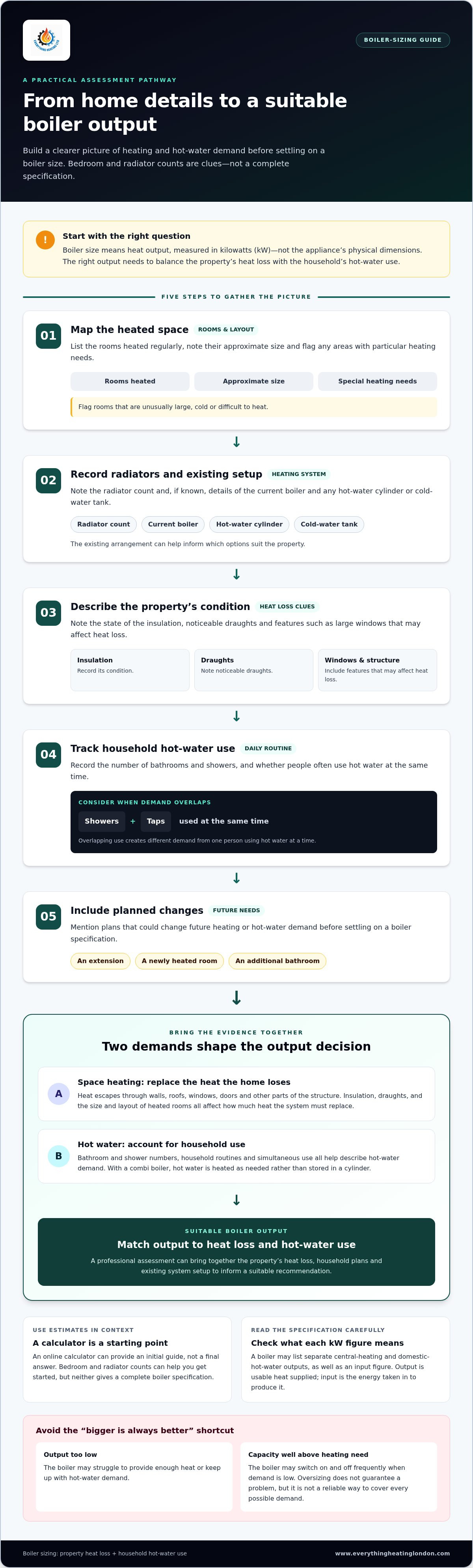
Before using a calculator or arranging an assessment, note which rooms you heat, how the property is laid out and how many radiators it has. Flag any rooms that are unusually large, cold or difficult to heat. This helps build a picture of demand across the home instead of relying on bedroom count alone.
- 1. Map the heated space. List the rooms you heat regularly, their approximate size and any areas with particular heating needs.
- 2. Note the radiators and existing system. Record the radiator count and, if known, details of the current boiler, hot water cylinder or cold-water tank. The existing setup can help inform which options suit the property.
- 3. Describe the property’s condition. Note the state of the insulation, noticeable draughts and features such as large windows that may affect heat loss. A professional assessment can examine the property in more detail.
- 4. Track hot water use. Record the number of bathrooms and showers, and whether people often use hot water at the same time. Overlapping showers and tap use create different demand from one person using hot water at a time.
- 5. Include planned changes. An extension, a newly heated room or an additional bathroom could change future heating or hot water needs. Mention these plans before settling on a boiler specification.
Why do heat loss and hot water demand both matter?
Heat loss is the rate at which warmth escapes through a home’s walls, roof, windows, doors and other parts of its structure. Insulation, draughts, and the size and layout of heated rooms all affect how much heat the system must replace. A room-by-room view can therefore be more useful than the number of bedrooms on its own.
Bedroom count alone can’t determine the correct boiler output, because heat loss and hot water use vary from home to home. Household routines matter too. Frequent simultaneous hot water use may influence which system type fits best, as well as the output needed for hot water.
For more context on the installation process, read this boiler installation guide for West London. If you’re choosing the right size boiler for my home, gathering these details is a practical first step. Everything Heating Ltd can bring them together in a professional assessment as part of its boiler installation service.
Combi, System or Regular Boiler: Which Type Fits Your Home?
Boiler type determines how your home gets hot water and how the heating system is arranged. It’s a separate decision from output. First consider how your household needs heating and hot water delivered, then assess the capacity required. A higher kW rating isn’t automatically better. The right choice depends on the property, its existing setup and your daily routine.
| Boiler type | System arrangement | Hot water setup | Household fit |
|---|---|---|---|
| Combi | Heats water for radiators and taps directly, without a separate hot water cylinder. | Heats water on demand. | May suit a home that prefers not to keep a cylinder and whose hot water use can be met by the boiler’s flow. |
| System | Works with a separate hot water cylinder. | Heats and stores hot water in the cylinder. | May suit households with higher hot water demand or more than one bathroom. |
| Regular | Works with a hot water cylinder and a cold-water storage tank. | Stores heated water in the cylinder. | May suit a home with an existing regular system, where retaining that arrangement makes sense. |
When might a combi boiler suit a household?
A combi provides central heating and hot water without a separate cylinder, which can suit households that don’t want to store hot water in the home. Consider how and when people use taps and showers. A combi’s hot water flow is shared across outlets, so simultaneous use can affect the flow available at each one. Suitability depends on both household routines and the property’s water supply.
When might a system or regular boiler make more sense?
A cylinder stores hot water for use around the home. This can be useful when household members often need hot water at the same time, although the stored supply is finite and needs to be reheated. A system boiler works with a cylinder; a regular boiler also uses a cold-water storage tank. Existing tanks, the cylinder and pipework can affect whether retaining the current arrangement is practical.
Neither stored hot water nor on-demand heating is right for every home. Consider whether demand tends to overlap, how much space the existing setup occupies and whether you plan to change the layout or add bathrooms.
Once you’ve considered the system type, assess its output against the home’s heating and hot water requirements. For choosing the right size boiler for my home, don’t select a higher kW rating just because it sounds like extra capacity. A professional assessment can match the boiler type and output to the property, existing system and household needs.
Boiler Size Checklist: What to Check Before Choosing a New Boiler
A checklist helps you compare boiler type, output and your existing system before deciding what to install. A London flat, terraced home or period property doesn’t come with a standard boiler size. Age and style alone can’t tell you how much heat a property loses. Insulation, draughts, layout and household use all matter, so don’t assume a particular property type needs a particular output.
What should you include in a boiler-sizing checklist?
Write down what you know about your home and how you use it. You don’t need to calculate the final output yourself. These details will make a professional assessment more useful.
- Heated areas: List the rooms you heat regularly, the radiator count and any rooms that are consistently difficult to warm.
- Hot water needs: Note the number of bathrooms and showers, and whether household members usually need hot water at the same time.
- Property condition: Record insulation concerns and noticeable draughts. Include any planned extension, additional heated room or bathroom that could change future demand.
- Existing system: Note the current boiler details if available, and whether the system includes a hot water cylinder or storage tanks. A photo of the boiler information label can help identify its details.
For example, don’t assume a period terrace loses more heat than a newer flat, or that a flat’s compact layout means its heating demand is low. The actual condition and arrangement of each home need to be considered.
How should you use online boiler size calculators?
A calculator can help organise your information and highlight questions to discuss. Check what it asks about, such as occupancy, insulation, heated rooms and hot water use. If it relies mainly on bedrooms or property type, it may not reflect the details of your home. Treat the result as a rough guide, not a final boiler specification.
Use calculator estimates as a starting point, then review them against your home’s actual heating and hot water needs. This is particularly useful if your system has a cylinder or tanks, or if you’re planning changes that a basic calculator may not account for.
For more on the wider process, read this boiler installation guide for West London. If you’re choosing the right size boiler for my home, use your checklist to support a property-specific assessment. Arrange a boiler installation assessment with Everything Heating Ltd.
Get the Right Boiler Size with a Professional Assessment
General sizing guidance can help you compare options, but a recommendation for your home should reflect the property and how you use heating and hot water. A professional assessment brings those details together before a boiler is selected. It turns your research into a practical discussion about boiler type, output and the installation work involved.
What happens during a professional boiler assessment?
The assessment should consider how much heat your home loses, which rooms need heating and how the existing system is arranged. It should also cover your hot water setup, household routines and any planned changes, such as an extension or additional bathroom. These details give a clearer picture than a single figure from a calculator.
The findings help inform which boiler arrangement may suit the property and what output is appropriate for its heating and hot water needs. They can also highlight installation requirements related to the existing system. The recommendation depends on the property’s needs, so avoid settling on a specific boiler size before those details have been considered.
Bring any information you have about your current boiler, cylinder or tanks, along with notes on rooms that are difficult to heat and when hot water is used at the same time. You don’t need to arrive with a technical answer. Practical details about how the home behaves day to day give the assessment a stronger starting point.
How can you move from boiler choice to installation?
Once the home’s needs and existing setup have been reviewed, the next step is to discuss a suitable boiler type and output, then plan the installation around the property. A Gas Safe registered professional can advise on the boiler and installation requirements. Everything Heating Ltd is Gas Safe registered and provides boiler installation in London.
If you’d like more detail on what an installation can involve, read the West London boiler installation guide. Choosing the right size boiler for my home is easier with a property-specific assessment than by relying on a rule of thumb alone.
Arrange a boiler installation enquiry with Everything Heating Ltd to discuss your home’s requirements.
Make Your Next Boiler Choice with Confidence
Choosing the right size boiler for my home isn’t about picking the highest kW rating or relying on bedroom and radiator counts alone. The right choice balances your property’s heat loss with your household’s hot water needs. Boiler type matters too: combi, system and regular boilers handle hot water differently, and your existing setup may influence what suits your home.
Use online tools and your own notes as a starting point. A professional assessment can bring together the home’s heating demand, hot water use, current system and future plans before a boiler is recommended. That gives you a clearer basis for discussing both output and installation.
Everything Heating Ltd is Gas Safe registered and provides boiler installation, servicing and repair. Take the next step with a property-specific discussion: arrange a boiler installation enquiry.
With the right information and expert guidance, you can move forward with a boiler choice that fits your home and household routine.
Frequently Asked Questions
What size boiler do I need for my home?
The right boiler output depends on your home’s heat loss, heating system and hot water demand. Bedroom and radiator counts provide useful starting context, but they can’t establish a suitable size on their own. Boiler type matters too, particularly with a combi, which needs to meet hot water demand as it arises. Use general guides for orientation, then base your choice on a property-specific assessment.
Is a bigger boiler always better?
No. A higher output doesn’t automatically mean better comfort or efficiency. An undersized boiler may struggle to meet your home’s heating or hot water demand, while an oversized one may not match what the system needs. Suitable output depends on heat loss, hot water use and boiler type together. Avoid choosing the biggest option as a safeguard. A property-specific assessment can help establish a better balance.
Can I choose a boiler size based on the number of radiators?
Radiator count is useful information, but it isn’t enough to determine boiler output. Radiators vary in size, and the rooms they heat may lose warmth at different rates. Insulation and household hot water use also affect the assessment. Record the number of radiators, but treat sizing charts as a rough guide rather than a final specification. A professional can consider the complete heating system and the property’s requirements.
How does insulation affect the boiler size my home needs?
Insulation affects how quickly a home loses heat. A well-insulated property may have a different heating demand from a similar-sized home with more heat loss, but insulation alone can’t determine boiler output. Note any draughts and the condition of windows, walls and roof insulation. Sharing these details helps an assessment build a fuller picture of heat loss across the property and how the heating system needs to respond.
What size combi boiler do I need for my home?
A suitable combi needs to meet your home’s heating needs and supply hot water on demand. Its output depends on heat loss, the hot water flow your household needs and how often taps or showers are used at the same time. Room or bedroom count alone won’t settle the question. Consider your daily routine, then review the property’s needs alongside the boiler’s separate heating and hot water specifications.
Is a combi, system or regular boiler best for my home?
There’s no single best type for every home. A combi heats water on demand without a separate hot water cylinder. System and regular boilers work with stored hot water, and a regular system also uses a cold-water storage tank. Your hot water routines, existing cylinder, tanks and pipework all influence the choice. Compare how each arrangement fits your household and property, rather than choosing by boiler output alone.
Do I need a professional to work out my boiler size?
A professional assessment is the best way to turn general sizing guidance into a property-specific recommendation. Online calculators depend on the details and assumptions entered, while an assessment can consider heat loss, the existing heating system, hot water demand and installation requirements together. Use a Gas Safe registered business for gas boiler installation. In London, Everything Heating Ltd provides boiler installation, servicing and repairs as a Gas Safe registered business.


