

It’s 3:00 AM, the house is silent, and suddenly your boiler starts sounding like a drum kit falling down the stairs. You lie there wondering if the unit is about to explode or if you’re facing a massive emergency repair bill. If you have a boiler making banging noise, you aren't alone. It’s one of the most common calls we get from homeowners across London, and it is usually more about limescale than a looming explosion.
We understand that a noisy heating system is more than just a nuisance; it’s a source of genuine anxiety. You want your home to be a place of quiet comfort, not a construction zone. You deserve to know exactly what is happening behind that white metal box without the confusing jargon. This guide will help you understand why your boiler is making these scary sounds and provide the straight-talking steps needed to fix the problem safely.
We will explore the specific impact of London’s notorious hard water on your pipes and explain common issues like kettling and trapped air. From simple checks you can do yourself to knowing when it is time to call a Gas Safe registered engineer, you will find everything you need to silence the racket and regain your peace of mind.
Key Takeaways
- Learn to distinguish between a single loud bang and repetitive popping to identify the specific fault in your heating system.
- Understand why a boiler making banging noise is often caused by 'kettling', where water trapped against the heat exchanger turns to steam.
- Discover how London's hard water profile contributes to mineral build-up, making local systems more prone to these disruptive sounds.
- Follow a safe, logical checklist to troubleshoot simple issues yourself whilst waiting for professional assistance.
- Learn when a standard service isn't enough and why a professional power flush is the ultimate deep clean for your pipes.
Identifying Why Your Boiler is Making a Banging Noise
A boiler making banging noise is rarely just "one of those things." It is a specific symptom of an internal mechanical struggle. To find a solution, you first need to play detective. Not all bangs are created equal, and the timing of the sound tells us exactly where the fault lies. Start by listening to the rhythm and the frequency of the noise. A rhythmic, metallic clanging suggests something very different than a dull, heavy thud.
Is it a single, sharp bang, or a series of repetitive pops? You should also observe exactly when the sound occurs. Note if it happens during the initial firing phase, whilst the system is running at full tilt, or just after it shuts down. Finally, check the location. A noise vibrating amongst the floorboards or behind walls is usually an issue with pipe expansion or "water hammer." However, a sound originating from inside the white metal casing of the unit itself points to a component failure or a circulation problem.
The 'Kettling' Sound: Like a Boiling Kettle
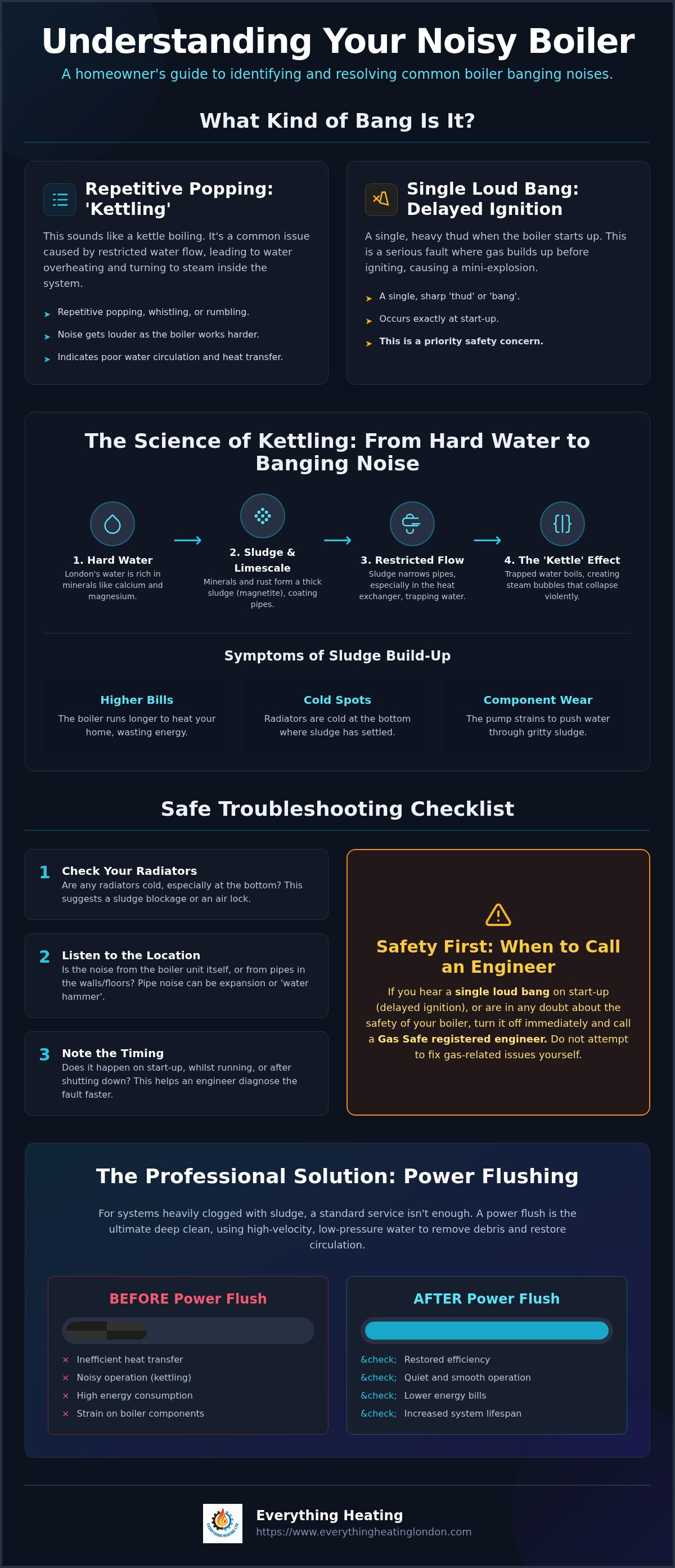
If your system sounds like a kitchen kettle reaching its boiling point, you are experiencing "kettling." This manifests as a repetitive popping, whistling, or deep rumbling noise. It is often the most common complaint we hear regarding older heating systems in London. The sound usually starts quietly and becomes significantly louder as the boiler works harder to meet the temperature on your thermostat. This happens because water flow is restricted, causing the water to overheat and turn into steam bubbles that pop violently against the metal heat exchanger. It is a sign that your system is struggling to move heat away from the burner efficiently.
Delayed Ignition: The Single Loud Thud
A single, heavy thud the moment your boiler starts up is a priority safety concern. This is known as delayed ignition. It occurs when gas builds up inside the combustion chamber because the pilot light or spark electrode fails to ignite it instantly. When the gas finally catches, it creates a small "mini-explosion" inside the unit. This isn't just a noise; it is a sign of a serious mechanical fault that could lead to cracked heat exchangers or damaged seals. If you hear this specific bang, you must stop using the system and contact a Gas Safe engineer immediately to ensure the unit remains safe for your home.
The Science of Kettling and Central Heating Sludge
The heat exchanger is the heart of your boiler. It is a dense network of metal pipes where the heat from the gas burner transfers to the water circulating through your home. When this component is clean, the heat transfer is silent and efficient. However, if your boiler making banging noise is a daily occurrence, the heat exchanger is likely suffering from "kettling."
Kettling happens when the water flow through the heat exchanger is restricted. Instead of the water flowing smoothly and carrying heat away, it gets trapped against the metal surfaces. It reaches boiling point almost instantly, turning into steam bubbles. These bubbles then collapse and pop violently as they meet cooler water, creating that distinctive banging or rumbling sound. It is a physical reaction to localised overheating inside the unit.
How Sludge Blocks Your System
The primary culprit behind restricted flow is magnetite, commonly known as central heating sludge. This is a black, muddy substance formed by a chemical reaction between the water in your system, oxygen, and the internal metal of your radiators. Over time, this debris breaks off and travels through your pipework, eventually settling in the narrowest parts of the boiler.
Sludge acts as an insulator. It creates a layer between the water and the heat exchanger, leading to "hotspots." The boiler has to work much harder to push heat through this layer of muck. This doesn't just cause noise; it significantly reduces your system's efficiency. You might notice several symptoms:
- Higher Bills: Your system runs longer to reach the same temperature.
- Cold Spots: Sludge settles at the bottom of radiators, leaving them cold to the touch.
- Component Wear: The pump and valves have to push through thick, gritty water.
If you suspect a build-up of debris is the reason for your noisy system, a professional boiler repair or system flush can often restore the quiet and lower your running costs.
Air Locks and Faulty Pumps
If your boiler making banging noise sounds more like a rhythmic clicking or a metallic "clack," it might be an air lock or a pump issue. Trapped air pockets disrupt the steady flow of water, causing it to surge and crash against the pipe walls. This air can often be removed by bleeding radiators, but persistent air locks may point to a leak or a fault in the system's design.
Your boiler pump is responsible for pushing water around the entire circuit. If the pump begins to fail, it cannot move the water fast enough to prevent it from overheating at the heat exchanger. A faulty pump might also produce a constant high-pitched vibration or a mechanical grinding sound. Distinguishing between a deep mechanical bang and a high-frequency vibration helps an engineer identify whether the issue is a simple air lock or a component that needs replacing.
Why Hard Water Areas in London Face More Boiler Noise
Londoners face a unique challenge when it comes to home maintenance. Our water is amongst the hardest in the UK. Whilst this is fine for drinking, it is a nightmare for your heating system. If you have a boiler making banging noise, the geology of the South East is often the silent culprit. The water in our capital is drawn from underground aquifers in the Thames Valley, where it filters through layers of chalk and limestone. This process leaves the water packed with dissolved calcium and magnesium.
These minerals don't stay dissolved forever. When they hit the high temperatures inside your boiler, they crystallise. This creates a hard, chalky deposit known as limescale. In soft water regions like Scotland or Wales, a boiler might easily reach its 15-year milestone with minimal fuss. In London, the same unit often struggles after just five or six years without proper protection. The minerals effectively bake onto the internal components, slowly choking the system from the inside out.
Limescale Buildup on the Heat Exchanger
The scale doesn't just sit there. It coats the internal metal surfaces of the heat exchanger in a thick, insulating crust. Think of it as "system cholesterol." It restricts the flow and forces the burner to run much hotter than designed to penetrate the layer of stone. This extreme heat causes the water trapped behind the scale to flash into steam instantly. That is the moment you hear the violent banging. It is the physical sound of steam bubbles collapsing under immense pressure. To prevent this, we recommend installing a magnetic filter or a scale reducer. These simple additions catch debris and neutralise minerals before they can bake onto your components. It is a small investment that can save you from a full system replacement.
Localised Issues in West London
Certain areas feel this pressure more than others. In postcodes around Greenford and Uxbridge, the water hardness is particularly high. Many homes in these areas are older properties with original, narrow-bore pipework. These systems are far more susceptible to blockages. A small amount of scale that might be a minor nuisance in a modern house can completely choke an older West London system. When the pipes are narrow, the water has less room to move, making the sounds even more resonant throughout the house. Solving a boiler making banging noise in these areas often requires a more thorough approach than a simple part swap. This is why regular boiler repair West London is vital. It isn't just about fixing a break; it's about managing the inevitable mineral buildup that comes with living in the capital.
Troubleshooting: What to Do Whilst Waiting for an Engineer
Hearing your boiler making banging noise can be unsettling. However, you don't have to sit in the dark feeling helpless. There are several safe, logical checks you can perform right now. These steps don't require tools or technical expertise. They help you narrow down the issue and provide vital information for your engineer.
Before you start, remember our straight-talking safety rule. If a task involves removing the boiler casing or touching gas components, leave it alone. These are strictly for Gas Safe registered professionals. Your focus should be on the external parts of the system that are designed for homeowner interaction.
Check Your Boiler Pressure
The first thing to look at is the pressure gauge on the front of your unit. For most systems, the needle should sit between 1 and 1.5 bar when the heating is off. If the needle is pointing towards zero, your system is under-pressurised. Low pressure allows air to enter the pipes, which often leads to the very banging sounds you are hearing.
Investigating the boiler losing pressure cause is a key part of troubleshooting. It might be a tiny leak from a radiator valve or a fault with the expansion vessel. If the pressure is low, you can try topping it up using the filling loop. However, if it drops again quickly, you need professional eyes on the system. A system that constantly loses pressure will eventually lock out and leave you without heat or hot water.
Bleeding Your Radiators
If the banging sounds like it is coming from the pipes rather than the boiler itself, you might have trapped air. Bleeding your radiators is a simple way to release this. Use a radiator key to open the small valve at the top of each radiator. If air hisses out, you have found a problem. Once water starts to trickle, close the valve immediately. This simple maintenance task often resolves minor knocking sounds and ensures your radiators heat up evenly from top to bottom. Remember to check your pressure gauge again after bleeding, as this process can cause the pressure to drop.
Checking for Error Codes
Modern boilers are quite clever. They often perform their own internal diagnostics. Look at the digital display on your control panel. If you see a flashing number or a combination of letters and symbols, write it down. This is an error code that tells us exactly what the sensors are detecting.
You can use our boiler fault codes explained guide to see what your specific model is trying to say. Whether it points to a pump failure or an ignition fault, having this code ready will help your engineer arrive with the right parts. If these basic checks don't silence the racket, it is time to book a professional boiler repair to get your home back to normal.
Professional Boiler Repairs and Power Flushing in West London
While the troubleshooting steps we discussed can help with minor air pockets, a boiler making banging noise often requires more than a quick fix. An annual service is vital for safety, but it doesn't always address the deep-seated sludge and scale that builds up over years of use. In London, where water hardness is a constant battle, your system eventually needs a professional deep clean to function correctly.
At Everything Heating Ltd, we have been tackling noisy systems across London since 2018. As Gas Safe registered specialists, we don't just swap parts and hope for the best. We look at the health of your entire heating circuit. We focus on providing straight-talking advice and long-term solutions that stop the noise at its source.
The Power Flushing Process
A power flush is the ultimate detox for your heating system. We connect a specialised, high-velocity machine to your pipework that circulates water and cleaning chemicals at high speed but low pressure. This combination strips away the magnetite sludge and calcium deposits that have baked onto your heat exchanger. We use magnetic filters during the flush to trap debris, ensuring the mess stays inside our equipment and not on your carpets. It is a clean, efficient process that restores your system to its original performance.
The results are immediate and noticeable. You will enjoy several benefits:
- Quieter Operation: Removing the scale stops the steam bubbles from popping in the heat exchanger.
- Hotter Radiators: Heat can finally reach the surface of the metal without being blocked by a layer of sludge.
- Lower Bills: Your boiler won't have to run at maximum power just to get the house warm.
Investing in a professional flush can extend the life of your boiler by several years. It protects the pump and valves from the abrasive grit that causes premature failure and expensive repairs.
When to Call an Emergency Engineer
Not every noise can wait for a scheduled appointment. There are specific "danger signs" that mean you should turn off your gas supply and seek professional help immediately. If you notice a faint smell of gas, see brown scorching marks on the boiler casing, or if the boiler making banging noise sounds like heavy metal hitting metal, it is an emergency. These signs suggest a serious internal failure that could compromise your safety.
For those in West London, our emergency boiler repair Uxbridge service provides a rapid, local response. We understand that a cold, noisy house is stressful. Our engineers provide clear solutions to get your system safe and silent again. Don't ignore the warning signs; it is always better to be safe than to face a total system breakdown or a dangerous fault.
Restore Quiet and Efficiency to Your Home
A boiler making banging noise isn't something you should just learn to live with. It is a clear signal that your heating system is struggling against London’s hard water or a build-up of internal sludge. By identifying the type of sound and checking your system pressure, you have already taken the first steps toward a solution. Whether your unit needs a simple part replacement or a professional power flush, addressing the issue now prevents a minor nuisance from turning into a major emergency.
You deserve a heating system that works silently and efficiently. Our team of Gas Safe Registered Engineers are local London experts who specialise in providing no-nonsense, reliable service. We focus on clear communication and practical fixes that restore your peace of mind without hidden complications. Don't let a noisy boiler disrupt your sleep or hike up your energy bills any longer.
Book a Straight-Talking Boiler Repair in London today. We will get your heating back on track with the straightforward, expert care your home needs.
Frequently Asked Questions
Is it dangerous if my boiler is making a loud banging noise?
While a banging boiler is rarely about to explode, it is a sign of internal mechanical stress that shouldn't be ignored. Certain noises, such as a heavy thud during ignition, point to gas build-up which is a priority safety concern. Persistent banging can eventually cause the heat exchanger to crack, leading to water leaks or a total system failure that is much more expensive to resolve.
Can low water pressure cause my boiler to make a banging sound?
Yes, low water pressure is a frequent reason for a boiler making banging noise. When the pressure gauge drops below 1 bar, air can enter the system or the flow rate can become too slow to carry heat away from the burner effectively. This leads to localised overheating and the resulting banging or rumbling sounds. Checking and topping up your pressure is often the first thing an engineer will suggest.
Why does my boiler bang once loudly when it first fires up?
A single loud bang the moment your boiler starts is usually caused by delayed ignition. This happens when gas builds up in the combustion chamber before the spark electrode can ignite it, resulting in a small, contained explosion when it finally catches. This is a mechanical fault that requires an urgent visit from a Gas Safe registered engineer to ensure your unit remains safe for use.
How much does it cost to fix a banging boiler in London?
The cost of a repair depends entirely on the underlying cause and the specific parts required to fix it. A simple pressure top-up or radiator bleed is a task you can often manage yourself for free, whilst replacing a failed pump or performing a full system deep clean involves professional labour and specialised equipment. We always provide straight-talking advice so you know exactly what is needed to get your system silent again.
Will bleeding my radiators stop the boiler from making noises?
Bleeding your radiators will stop the noise if the sound is caused by trapped air pockets. If you hear "water hammer" or knocking sounds travelling through the pipes, releasing the air often restores a smooth, quiet flow. However, if the noise is originating from inside the boiler casing itself, the issue is more likely related to limescale build-up or a failing component rather than air in the radiators.
What is 'kettling' and can it be fixed without a new boiler?
Kettling is the sound of water turning to steam against a scaled-up heat exchanger, and it can almost always be fixed without replacing the entire boiler. A professional power flush or the installation of a scale reducer often removes the mineral deposits and restores quiet operation. It is a highly effective way to extend the life of your current heating system and improve its energy efficiency.
How often should I have my system power flushed to prevent noise?
Most heating systems benefit from a professional power flush every 5 to 10 years to maintain efficiency and prevent a boiler making banging noise. However, in hard water areas like West London, you might need this service sooner if you notice radiators have cold spots or the boiler starts rumbling. Regular annual servicing helps an engineer identify when a flush is becoming necessary before a breakdown occurs.
Why is my boiler making a banging noise even when the heating is off?
If your boiler bangs when the heating is off, it is often due to the "pump overrun" feature or pipes contracting as they cool down. The pump may continue to move hot water through the system for several minutes after the boiler shuts down to protect internal components. If the noise sounds like metallic clicking, it is likely just the copper pipes settling in their brackets as they change temperature.


