

It is 6:00 AM on a freezing January morning, and you have just discovered your radiators are stone-cold whilst your boiler display flashes a cryptic "F1" or "E106". It is a moment of pure frustration that usually leads to a frantic search for a dusty manual or the fear of a massive repair bill. You are not alone in this. Research shows that one in six UK homes contains an unsafe gas appliance, making these digital warnings more than just a minor nuisance. This guide to boiler fault codes explained aims to remove the mystery from your heating system. We want to replace that initial panic with a sense of calm, practical control.
We understand that technical jargon often makes a simple problem feel like a catastrophe. That is why we have broken down the most common errors into plain English. You will learn exactly what your boiler is trying to tell you and which minor glitches you can safely fix with a quick reset or a pressure top-up. We will also be clear about the serious faults that require a Gas Safe registered professional in London. By the end of this article, you will know whether you need a simple DIY tweak or a specialist engineer to get your home warm again.
Key Takeaways
- Learn the crucial difference between a temporary "blocking" error and a total "locking" safety shutdown to understand how your system reacts to faults.
- Use our boiler fault codes explained section to compare how Worcester Bosch, Vaillant, and Ideal display common issues like low pressure or ignition failure.
- Save time and money by identifying which simple pressure or condensate pipe fixes are safe to handle yourself before booking a repair.
- Protect your home by recognising the specific warning signs that signal a carbon monoxide risk or a gas-related fault that must be handled by a professional.
- Understand how London’s hard water leads to recurring circulation codes and why preventative servicing is the key to a fault-free winter.
Understanding Boiler Fault Codes: Why Your Heating Has Locked Out
When your boiler stops working, it can feel like the machine is being stubborn. In reality, it is performing a vital safety function. A boiler fault code is a specific diagnostic signal sent by the internal computer to tell you exactly why the system has stopped. Having these boiler fault codes explained helps you understand that your appliance isn't just "broken"; it is communicating a specific mechanical or electrical issue that needs attention to keep your home safe. These codes act as an early warning system, often preventing minor issues from turning into expensive or dangerous failures.
The Role of the Printed Circuit Board (PCB)
Think of the Printed Circuit Board, or PCB, as the brain of your Central heating system. It constantly communicates with sensors positioned throughout the boiler, monitoring everything from water pressure to gas flow and heat levels. If any sensor sends back a reading that falls outside of pre-set safe parameters, the PCB reacts instantly. It might try to adjust the performance first, but if the risk is too high, it triggers an immediate shutdown. The PCB is the central control hub that prioritises safety over operation.
Lockout vs. Blocking: What is the Difference?
Not every error code means your boiler is completely out of action. Many brands use "blocking" errors for temporary issues. For example, if the boiler gets slightly too hot, it might "block" operation until the temperature drops to a safe level. Once the conditions improve, the boiler starts up again automatically. A "lockout" is different. This is a hard stop that prevents the boiler from firing up until someone intervenes. Lockouts usually happen when the PCB detects a serious safety risk, such as a flame failure or a lack of water. It is a protective behaviour designed to prevent damage to the unit or, more importantly, to prevent gas leaks and carbon monoxide buildup in your home.
Before you assume the worst, there are a few basic checks you should perform. These don't require any tools or technical knowledge and can often resolve the issue without a call-out.
- Check your gas supply: If you have a prepayment meter, ensure you have credit. Check if other gas appliances, like your hob, are working correctly to rule out a wider supply issue.
- Look for obvious leaks: Walk around your radiators and the boiler itself. Even a small drip can drop the system pressure enough to trigger a fault code.
- The "Once-Only" Reset: Most boilers have a reset button. Press it once. If the code clears and the boiler runs normally, it may have been a one-off glitch. If the code returns immediately, don't keep resetting it; this indicates a genuine fault that needs professional attention.
Deciphering the Most Common Fault Codes by Brand
Every manufacturer uses its own unique alphabet of errors. However, having boiler fault codes explained across different brands reveals that the underlying mechanical issues are remarkably consistent. Whether your screen shows an "F", an "L", or an "E", the boiler is usually reacting to a drop in pressure, a lack of gas, or a circulation problem. Whilst the symbols vary, the logic remains the same. We recommend keeping your physical manual in a safe place, but most modern brands provide digital PDFs online if you search for your specific model name and year.
Worcester Bosch Error Symbols and Codes
The EA code is the one we see most often during London winters. It signifies an ignition failure, which is frequently caused by a frozen condensate pipe. If your boiler display is flashing a blue light, it is usually a signal that the system has locked out and needs a manual reset. You might also see a "Key" symbol on the display. This isn't a fault; it is simply the child lock. Hold the reset or key button for a few seconds to clear it and regain control of your heating settings.
Vaillant F-Series Faults
Vaillant boilers use "F" codes to communicate status. The F22 code is the most frequent user-fixable issue, indicating that your water pressure has dropped too low. If you see F75, the boiler is struggling with a pump or sensor fault. This often requires a professional part replacement because the boiler cannot "see" the pressure change when the pump starts. For issues involving the gas supply, you will likely see F28 or F29. Because these involve the internal combustion process, they are strictly governed by the Gas Safety Regulations 1998, meaning you must never attempt to investigate the internal gas components yourself.
Ideal Heating L and F Codes
Ideal boilers split their warnings into "F" (fault) and "L" (lockout) codes. An F1 code is their standard signal for low water pressure, while L2 indicates an ignition lockout. Homeowners often get confused by the "Pre-heat" symbols, which look like a small "c" or a tap; these are normal operating modes, not errors. However, if you see an L1 code, take it seriously. This is a potential overheat signal. It is a safety shutdown that requires immediate attention to prevent damage to the heat exchanger. If you find yourself staring at a recurring code that won't clear, a professional boiler repair can prevent a minor glitch from becoming a total system failure.
Troubleshooting the Big Three: Pressure, Ignition, and Condensate
Most boiler breakdowns in London are caused by the same three recurring issues. Having these boiler fault codes explained allows you to identify whether you are facing a simple maintenance task or a complex mechanical failure. By understanding the mechanical reason behind the error, you can often restore your heating in minutes without a call-out fee. However, if these DIY fixes don't work on the first attempt, it is a clear signal that a professional is required to prevent further damage.
Low Water Pressure (The #1 Fault)
Your boiler needs a specific volume of water to circulate heat effectively. If the pressure drops too low, the system shuts down to prevent the pump from running dry and burning out. Check the pressure gauge on the front of your unit; whilst cold, the needle should sit between 1.2 and 1.5 bar. If it is in the red zone near zero, you need to top it up using the filling loop. This is typically a silver braided hose with two small taps. Open both taps slowly until you hear water entering the system and watch the needle rise. Close them tightly once it reaches 1.5 bar. For a more detailed look at why your system might be leaking, check our guide on Boiler Losing Pressure? Common Causes and Fixes.
Ignition Failures and Gas Supply
If your boiler tries to fire up but fails, it will trigger an ignition lockout. First, verify you have an active gas supply. Check your meter for credit and ensure the yellow isolation valve is in the "on" position. Sometimes, a temporary glitch in the gas pressure or a minor air bubble causes a one-off error. Press the reset button once to see if the system clears and fires up. If the fault returns immediately or happens several times a week, you likely have a worn spark electrode or a faulty gas valve. These are internal components that must only be handled by a Gas Safe engineer.
Frozen Condensate Pipes in Winter
During a London cold snap, the external white plastic pipe that carries waste water away can freeze. This creates a blockage that backs up into the boiler, causing an instant safety shutdown. You can fix this safely by pouring warm (not boiling) water over the frozen section of the external pipe. Once the ice melts and the blockage clears, you will hear the water drain away. Perform a quick reset on the boiler to restore service. If the pipe is in an unreachable location or if the warm water doesn't solve the issue, do not attempt to dismantle the pipework yourself.
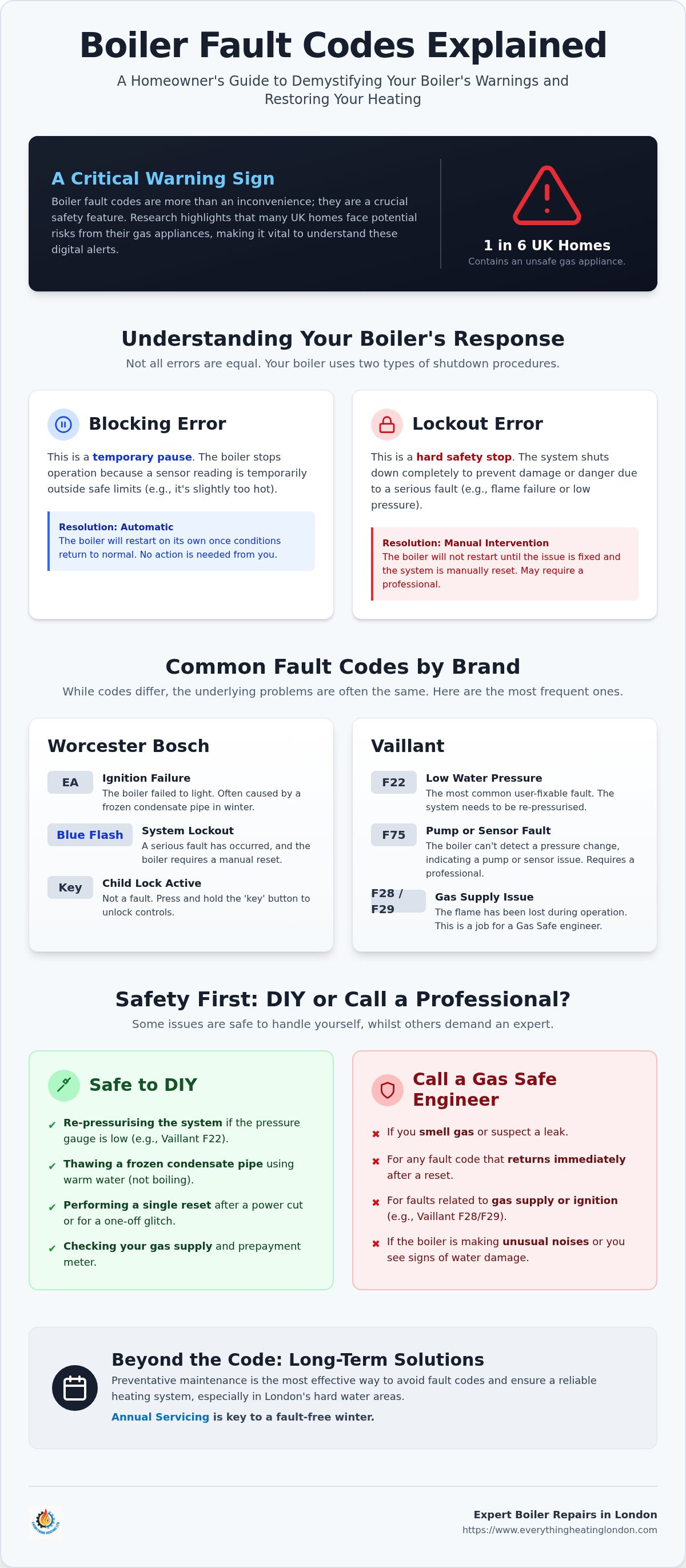
Safety First: When to DIY or Call a Professional
Understanding boiler fault codes explained isn't just about getting your hot water back. It is about knowing exactly where the "Gas Safe Line" sits. This is the boundary between a simple user adjustment and a dangerous repair. If a fix requires you to remove the boiler casing or touch any internal gas components, you must stop immediately. Opening the unit exposes you to live electrical parts and potential gas leaks. It also voids many manufacturer warranties and is legally restricted to registered professionals for a reason.
One of the biggest hidden dangers is carbon monoxide (CO). This colourless, odourless gas can leak if a boiler is firing incorrectly due to a blocked flue or a faulty internal seal. Certain error codes specifically indicate "flue gas" or "combustion" issues. If your display shows these, or if you notice soot marks around the boiler, turn off the gas supply and leave the building. Safety should always come before comfort.
The Dangers of Repeatedly Resetting
Many homeowners fall into the "Reset Trap". They press the reset button every time the boiler cuts out, hoping the problem will eventually go away. This is a mistake. Each reset forces the system to try and fire, which can worsen an internal leak or cause a component to overheat. If a code returns within 24 hours, it is a persistent fault, not a random glitch. The reset button is a diagnostic tool, not a repair method. Using it to mask a recurring issue only leads to more expensive damage later on.
When to Call a Gas Safe Registered Engineer
Specific codes point directly to internal failures that no DIY enthusiast should touch. If your display indicates a fan failure, a gas valve fault, or a PCB error, you need professional help. These components require precise calibration and testing once replaced. For those living in the capital, finding boiler repair West London specialists ensures you have an engineer who understands the local water conditions and common system setups. Only a registered professional can legally and safely handle gas-related repairs to ensure your home remains protected.
Watch out for these "Red Flag" symptoms that require an emergency engineer, regardless of the code shown:
- A strong smell of gas or "rotten eggs" near the boiler.
- Yellow or orange flames instead of a crisp blue one.
- Black soot marks or staining on the boiler casing.
- Loud banging, whistling, or vibrating noises during operation.
- The pilot light frequently going out.
If you are unsure about a code or if your boiler is behaving strangely, don't take the risk. Book a professional boiler repair today to get your heating back on safely.
Beyond the Code: Long-Term Solutions for a Fault-Free Boiler
Having boiler fault codes explained is vital when you are stuck in the cold. It helps you distinguish between a simple DIY fix and a serious safety risk. However, the most efficient way to manage your heating is to prevent these codes from appearing in the first place. Most modern boilers are highly sensitive. They react to the slightest change in water quality or component wear. By taking a proactive approach to your system health, you can avoid the stress of winter lockouts and extend the life of your appliance by several years.
Hard Water and Limescale in London
London is famous for its hard water, which is a significant factor in many recurring fault codes. Over time, calcium and magnesium deposits build up inside your heat exchanger. This creates a thick layer of limescale that acts as an unwanted insulator. The boiler then has to work much harder to heat the water, often leading to "overheat" or "kettling" error codes. This buildup also creates a heavy sludge that settles in the bottom of radiators and restricts flow. If your boiler frequently shows circulation faults, the issue is often the water quality rather than a broken part. A professional power flush clears this debris and restores the system to its original efficiency, preventing the sensors from triggering a shutdown.
The Power of the Annual Service
An annual service is far more than a quick visual check. During a professional visit, an engineer cleans the spark electrodes and inspects the flame sensors. These are the exact components that cause the ignition lockouts we discussed earlier. Dust and carbon buildup on these parts can lead to intermittent errors that eventually become permanent failures. A Gas Safe engineer will also check the expansion vessel and internal seals to catch minor leaks before they cause your pressure to drop. This is a critical step for safety; research shows that 20% of UK homes would currently fail a gas safety certification if inspected today.
Regular maintenance is also a financial necessity. Most manufacturer warranties are only valid if you can prove the boiler has been serviced every 12 months. Skipping a service might save a few pounds today, but it could cost you thousands if a major component fails and your warranty is voided. You can avoid the stress of cryptic fault codes and keep your home warm all winter by booking an annual boiler service today. Investing in prevention is always cheaper than reacting to an emergency.
Restore Your Comfort with Confidence
Now that you have had these boiler fault codes explained, the flashing numbers on your display should feel like a helpful guide rather than a source of panic. You now know how to safely top up your pressure and when a frozen pipe needs a simple warm water pour. Most importantly, you recognise the "Gas Safe Line" that protects your home from unnecessary risks. Whether it is managing the effects of London’s hard water or identifying a genuine component failure, clear information is your best tool for a warm house.
If your boiler is still refusing to fire or a code keeps returning, don't stay in the cold. Everything Heating Ltd has provided no-nonsense, expert advice across London since 2018. Our Gas Safe Registered Engineers prioritise transparency and reliability over complex jargon or high-pressure sales. Stuck with a fault code? Book a straight-talking boiler repair with Everything Heating today. We are here to help you get your heating back on track quickly and safely. You have got this; a warm, fault-free home is just a few steps away.
Frequently Asked Questions
Is it safe to reset my boiler if a fault code appears?
It is generally safe to reset your boiler once to see if the code was caused by a temporary glitch. However, you should never use the reset button as a way to "fix" a recurring problem. If the code returns within 24 hours, it indicates a genuine mechanical or electrical fault that requires professional attention. Repeatedly resetting can mask dangerous issues or cause further damage to internal components.
Why does my boiler keep losing pressure and showing a fault code?
Frequent pressure loss is usually caused by a small leak in the pipework, a radiator valve, or an issue with the internal expansion vessel. If you find your boiler fault codes explained as a low-pressure error multiple times a month, topping it up is only a temporary fix. You need an engineer to find the source of the leak or check the vessel's charge to prevent the system from locking out again.
Can I fix a boiler fault code myself or do I need an engineer?
You can safely handle simple tasks like topping up water pressure, thawing a frozen condensate pipe, or resetting a child lock. Any fault that requires opening the boiler casing or touching gas, electrical, or flue components must be handled by a Gas Safe registered engineer. Legally and for your own safety, you should never attempt to repair internal parts like the gas valve or PCB yourself.
What should I do if my boiler displays an ignition failure code?
First, check that your gas supply is active by testing another appliance like a hob or checking your prepayment meter for credit. If the supply is fine, try resetting the boiler once. Persistent ignition failure often points to a worn spark electrode or a faulty gas valve. Because these are internal gas-carrying parts, you will need a professional to diagnose and replace the faulty component safely.
How do I find the meaning of a specific fault code for my boiler brand?
The quickest way is to check the user manual that came with your appliance, as codes vary significantly between brands like Worcester Bosch, Vaillant, and Ideal. If you have lost the physical copy, most manufacturers provide digital PDF manuals on their websites. Simply search for your specific boiler model name followed by "manual" to find a comprehensive list of what each error symbol means.
Will a power flush stop my boiler from showing fault codes?
A power flush is highly effective at stopping "circulation" or "overheat" fault codes caused by sludge and limescale buildup. In London's hard water areas, debris often clogs the heat exchanger or pump, triggering a safety shutdown. By clearing this internal debris, the water can flow freely again, which prevents the sensors from detecting the high temperatures that lead to frequent lockouts.
What does a flashing red light on my boiler mean?
A flashing red light is a universal signal that your boiler has entered a "lockout" state for safety reasons. This usually accompanies a specific alphanumeric code on the digital display. It means the system has detected a fault, such as a lack of water pressure or a failure to ignite, and has stopped working to prevent damage or danger. Refer to your manual to see what the specific code indicates.
Can cold weather cause my boiler to show an error code?
Cold weather is a very common cause of error codes, particularly due to frozen condensate pipes. When the external plastic pipe freezes, waste water backs up into the boiler and triggers an instant shutdown. You can often resolve this yourself by pouring warm water over the external pipe to melt the ice. This is a common part of having boiler fault codes explained during the winter months in London.


